Muriwai Gannet Colony Day Trip from Auckland (2026)
Complete 2026 Muriwai gannet colony day trip guide — 1,200 breeding pairs, Aug-Mar season, viewing platforms, photography tips, sample itinerary.

This article contains advertising. Our booking links are routed through a partner that adds commission tracking automatically, so if you book through one we earn a commission from the provider, at no extra cost to you. It never affects what we recommend. Affiliate disclosure
The Muriwai gannet colony is one of Auckland’s most accessible wildlife experiences — a thriving population of 1,200 breeding pairs of Australasian gannets nesting just 50 minutes northwest of the CBD. Two purpose-built clifftop viewing platforms allow visitors to observe the gannets metres away during the August-March breeding season — including dramatic plunge dives, courtship displays, and chick-rearing. This complete 2026 Muriwai gannet colony day trip guide covers the colony, season timing, how to get there, photography tips, and the best half-day plan. Our Hauraki Gulf Islands guide covers this in more depth.
About the Muriwai Gannet Colony
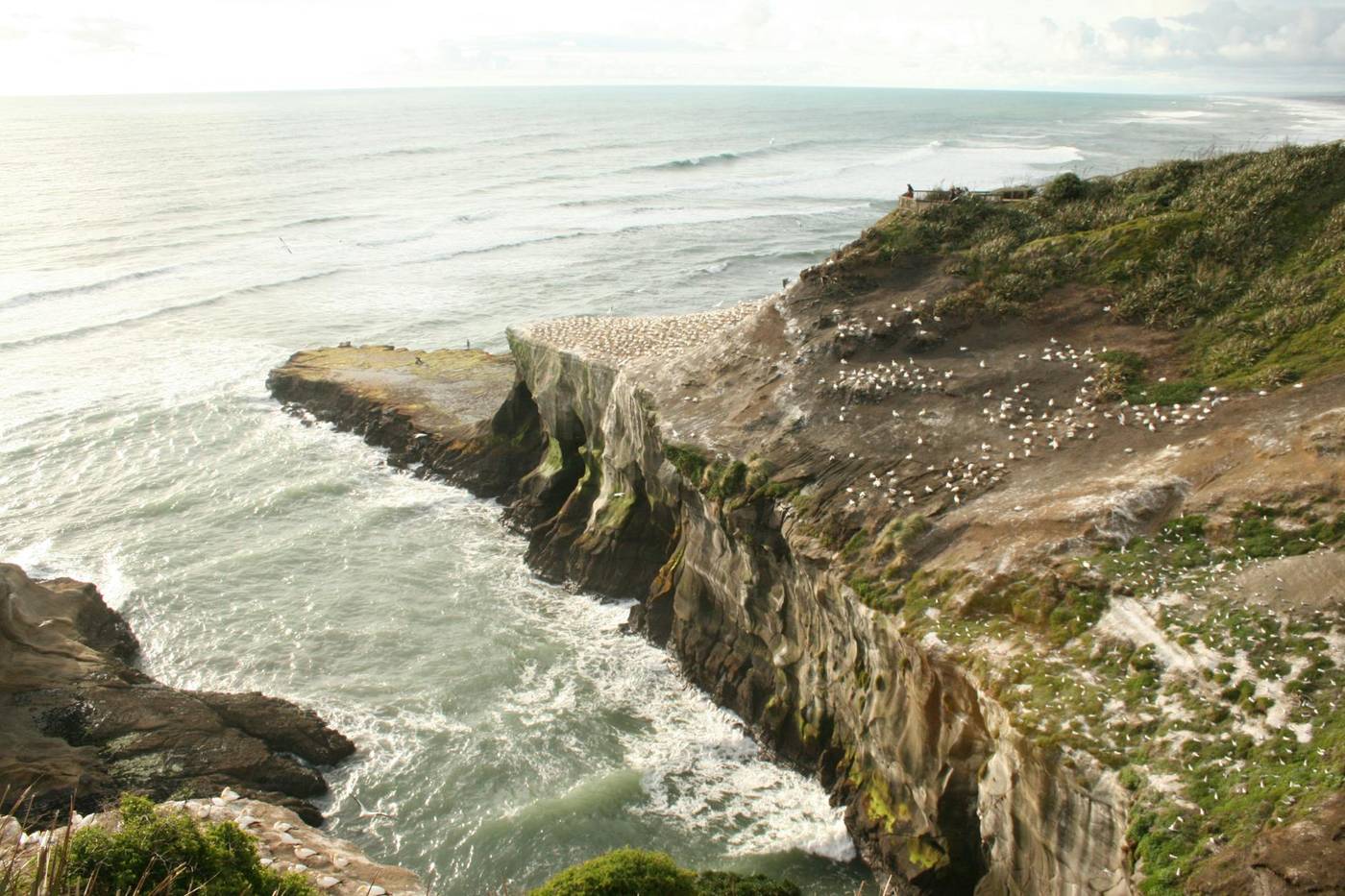
The Muriwai gannet colony is Australasia’s most easily accessible mainland gannet colony. Around 1,200 breeding pairs of Australasian gannets (Morus serrator) nest on the rocky promontory at the south end of Muriwai Beach and on adjacent Otakamiro Point. The colony has been growing since the 1970s after gannets first colonised these mainland sites — historically, gannets nested only on offshore islands.
| Detail | What to know |
|---|---|
| Where | Ōtakamiro Point, Muriwai Regional Park, 42km northwest of the CBD |
| Season | Birds present roughly August to March; terraces bare around May to July |
| Best months | October-November for courtship, December-January for chicks |
| Cost | Free, including parking |
| Getting there | About 50 minutes by car via SH16; there is no bus to Muriwai |
| The walk | Maukatia Gannet Track, about 1.3km and 25 minutes return from the Waitea Road car park |
| Time needed | 30-60 minutes at the lookouts; half a day with the beach added |
| Facilities | Toilets and a playground at the car park; dogs not permitted on the track |
| Before you go | Check the Maukatia Gannet Track status on the Auckland Council website |
The colony sits on Ōtakamiro Point, the headland separating Maukatia (Māori Bay) from the southern end of Muriwai Beach, with nesting spilling onto the ledges below and across to Motutara Island just offshore. BirdLife International lists the gannetry as an Important Bird Area. Note that this is Auckland Council land, not a DOC reserve, so track and closure information lives on the council’s regional parks pages.
Muriwai is one of only three mainland Australasian gannet colonies in the country – Cape Kidnappers holds around 5,000 breeding pairs, Farewell Spit roughly a thousand, and Muriwai sits in the same range as Farewell Spit. What makes this the one people visit is proximity, not size. One caveat: the headland closed after the 2023 storms and only reopened in December 2024, and the council then ran a full track rebuild from September 2025 to about the middle of 2026.
The Australasian Gannet
- Scientific name: Morus serrator
- Wingspan: 2 metres
- Length: 90cm
- Colour: White body, golden head, black wing tips
- Lifespan: 30+ years
- Diet: Fish, squid (caught by plunge-diving from 30m+)
- Breeding: Single egg per pair per season
- Diving speed: Up to 100km/h on impact
- Diving depth: Up to 22 metres below surface
The plunge dive is worth understanding. A hunting gannet stalls above a shoal, folds its wings into an arrowhead and hits the water hard enough to knock out most birds. It gets away with it thanks to a reinforced skull, no external nostrils, and air sacs under the skin of the face and chest that work as a crumple zone. The fish is usually taken on the way back up and swallowed underwater.
Breeding is slow. Gannets have no brood patch, so the single egg is incubated under their webbed feet. Chicks fledge 95 to 109 days after hatching, then fly to Australia alone and unfed – a crossing of six to fifteen days that only about 30 per cent survive. Survivors return after two to five years and most do not breed until they are four to seven. A gannet that gets through all of that can live 25 to 38 years.
Gannet Season at Muriwai

- August: Gannets return from their winter migration to Australia
- September: Pair-bonding rituals, nest-building begins
- October: Courtship displays — head-bobbing, sky-pointing, mutual preening
- November: Egg-laying (single egg per pair)
- December: Incubation period, first chicks hatching
- January: Peak chick-rearing — gannets fishing furiously
- February: Chick growth, parents diving constantly
- March: Chicks fledging, learning to fly
- April: Migration to Australia begins
- May-July: Colony empty
That calendar is accurate but it does not tell you what each window looks like from the lookout, so here is the version I would give a friend.
- August-September: the birds trickle back and the point is loud but scruffy, with pairs rebuilding nest mounds out of seaweed and mud. Fewer people, more weather.
- October-November: the best behaviour of the season – bill-fencing, sky-pointing, long bouts of mutual preening – and the colony at its tidiest.
- December-January: fat grey chicks everywhere and adults commuting constantly. The most dramatic window and the busiest, so go early.
- February-March: juveniles the size of their parents doing wing-stretching practice at the cliff edge. Watching a fledgling work up the nerve to launch is the best thing here.
- April: stragglers only. You are gambling.
- May-July: do not drive out expecting birds, and expect track work.
If your trip falls in the empty months the headland is still worth walking: the pillow lava formations above Maukatia are a genuine geological oddity and the blowhole works hard in a winter swell. Pair it with our wider Muriwai Beach guide and you still have a decent half day.
Best visiting times: December and January for chick-rearing peak, which also falls in Auckland’s peak summer season. October-November for courtship displays. If you only get one trip and want a full colony with active nests and birds fishing offshore, aim for the first half of January and arrive before 9am. For the colony at its most photogenic and least crowded, a late-October weekday is hard to beat. The window to avoid entirely is May to July, when you are looking at empty rock.
How to Get to the Muriwai Gannet Colony

Muriwai Beach is 42km northwest of Auckland CBD — a 50-minute drive. There is no public transport, so hiring a car is the simplest way out here. Driving directions:
- Take SH16 (Northwestern Motorway) west from Auckland CBD
- Continue past Kumeu and Waimauku
- Turn onto Muriwai Road, signposted
- Park at the gannet colony carpark (signposted at the south end of Muriwai Beach)
- Free parking
The last few turns catch people out. Head northwest on SH16 past Westgate, through Kumeu and Waimauku, turn left onto Muriwai Road, continue through the village onto Motutara Road and take Waitea Road up to the signposted Maukatia / Māori Bay car park. Putting 1 Waitea Road, Muriwai into your phone gets you to the right one – several spots in the village look right and are not.
- Timing: 50 minutes off-peak, closer to 75 if you leave the CBD between about 3.30pm and 6.30pm on a weekday.
- Fuel and food: the last reliable petrol, supermarket and ATM are at Westgate, Kumeu or Huapai. There is none of that at Muriwai.
- Parking: the Waitea Road car park has toilets and a playground, and fills on summer weekends.
- Public transport: there genuinely is none. The network reaches Westgate and Huapai and stops.
Mobile signal is patchy on the headland, so download your map first. If the winding final stretch worries you, our notes on driving in Auckland help, and anyone picking up a vehicle should check our Auckland car rental guide for the insurance traps.
For non-drivers, Auckland tour companies offer west coast day trips taking in Muriwai for around NZ$130-180 per person at the time of writing, usually looped with Piha, Bethells or the Waitākere Ranges. Check two things before booking. First, how long you actually get at the colony, because some itineraries allow barely 20 minutes. Second, whether the tour runs in the off-season, because operators keep selling west coast trips through winter when there are no gannets to see. Our roundup of day trips from Auckland puts Muriwai alongside the alternatives.
Visiting the Viewing Platforms
- Park at the gannet colony carpark
- Walk 5 minutes along the boardwalk to the first viewing platform
- Continue 2 minutes to the second platform overlooking Otakamiro Point
- Free admission, open 24 hours (best in daylight)
- Stay on the platforms — do not approach the birds
- Allow 30-60 minutes for proper viewing
This is a headland walk rather than a flat stroll. From the car park the path climbs away from Maukatia on a mix of sealed surface, timber steps and boardwalk, with a couple of short pinches. It is manageable for most people over about 1.3km return, but wear grippy shoes: the boardwalk goes slick in drizzle and the exposed sections are scoured by wind straight off the Tasman.
The rules at the top are not decoration. Stay behind the rails and off the rock – a gannet defending an egg will go for you. Dogs are not permitted on the track at all. Drones need an Auckland Council permit anywhere in a regional park, and permission over an active seabird colony is not something to count on. With avian influenza an ongoing concern for New Zealand seabirds, report sick or dead birds rather than touching them.
Accessibility is more nuanced than it is usually described. The large paved viewing area at the northern end, closest to Muriwai Beach, is the flat and genuinely accessible part, and it is the one to aim for with a wheelchair or a pram. The route in from Maukatia and Waitea Road involves timber steps and graded boardwalk with handrails – fine for steady walkers, not for wheels. Because the northern entrance from Motutara Road has been closed on and off during the recent rebuild, check with Auckland Council if step-free access is essential rather than assuming it is open.
What to Expect at the Colony

- Hundreds of gannets visible at any time during the breeding season
- Constant activity — landing, taking off, courtship, feeding chicks
- Plunge dives visible from the cliffs as gannets fish
- Loud calls filling the air
- Smell — colonies are pungent, prepare for it
- Other seabirds — white-fronted terns, red-billed gulls also nest in adjacent areas
What surprises first-timers is how unbothered the birds are. You stand ten to twenty metres away and they simply carry on. Pairs greet each other by clashing beaks in a rapid fencing motion; a bird about to take off points its bill at the sky and shuffles through the crowd to clear a runway. Be ready for the noise and the smell, in that order – a colony in December sounds like a football crowd heard through a wall.
Photography Tips
- Long lens recommended — 200-400mm for close-up shots
- Fast shutter speed — 1/2000+ for diving birds
- Late afternoon golden light — best for backlit gannet shots
- Otakamiro Point at sunset — gannets silhouetted against the Tasman Sea
- Wide-angle for scene context — birds against dramatic coastline
- Bring spare batteries — easy to spend hours photographing
- Be patient — best moments come from extended observation
What to Bring
- Camera with telephoto lens (or binoculars)
- Water and snacks
- Sunscreen — clifftop is exposed
- Hat and sunglasses
- Light jacket — west coast can be windy
- Sturdy walking shoes (boardwalk is fine but path to beach is rocky)
- Cash for nearby café (NZ$30)
On cost: the colony and the parking are both free, so the only real spend is getting there. A return trip from the CBD is about 84km, roughly NZ$20 of petrol in a small car at the time of writing. Two adults can do Muriwai as a self-drive half day for under NZ$60 all in.
- Binoculars beat a camera if you only bring one thing. Even cheap 8x42s transform the experience for non-photographers.
- Water: bring it. There is no shop at the car park and the walk is exposed.
- Wind layer: not optional, even in February.
- Sun protection: no shade at all on the headland, and fierce glare off the sea.
Combining Muriwai Gannet Colony with Other Activities

- Muriwai Beach walk — 60km of black sand beach south of the colony
- Goldie Bush Track — 2-hour return native bush walk to Mokoroa Falls (5 mins drive), one of the northern Waitākere Ranges hikes
- Te Henga Walkway — 8km clifftop walk south to Bethells Beach
- Kumeu wineries — 10 mins drive (Soljans, Hunting Lodge, Coopers Creek)
- Bethells Beach (Te Henga) — 15 mins drive south
- Piha Beach — 30 mins drive south
Not all of those combine equally well. Goldie Bush and the Mokoroa Falls track are the best add-on if you want bush after cliffs, though the return walk involves stream crossings and gets slippery in winter. Te Henga Walkway is a commitment at around 8km one way and becomes the day rather than an addition.
For a bigger loop, Muriwai pairs with the rest of the coast: Bethells is 15 minutes south, Piha is covered in our Piha and Waitākere Ranges day trip guide, and anyone stringing tracks together should start with our roundup of the best Waitākere Ranges hikes, checking kauri dieback closures first. The other natural pairing is wine – Kumeu is ten minutes back inland, and our guide to the best wineries near Auckland covers who is open when, since several cellar doors keep short winter hours.
Sample Muriwai Gannet Day
- 9am — Drive from Auckland CBD via SH16
- 9:45am — Coffee stop in Kumeu
- 10:30am — Arrive Muriwai gannet colony viewing platforms
- 11:30am — Walk south along Muriwai Beach
- 1pm — Lunch at The Hunting Lodge winery
- 2:30pm — Goldie Bush Track to Mokoroa Falls
- 4pm — Return to Muriwai for sunset views
- 5:30pm — Drive back to Auckland
- 6:30pm — Arrive Auckland CBD
That is the relaxed version. Two alternatives worth knowing:
- The photographer’s dawn plan: leave the CBD at 5.30am in summer, be on the headland for first light, shoot for two hours, breakfast in Kumeu, home before the traffic builds.
- The out-of-season version: May to July, skip the early start, walk the headland for the pillow lava and blowhole, walk the beach, and make Kumeu the main event.
The Colony’s Conservation Story

Gannets historically nested only on offshore islands due to predator pressure. Mainland nesting at sites like Muriwai is a relatively recent phenomenon (last 50 years), reflecting NZ’s success at predator control, the same work that turned Tiritiri Matangi into an open bird sanctuary. The Muriwai colony is now self-sustaining and growing slowly. Auckland Council and the Department of Conservation manage the site for conservation and visitor access.
Protection here is older than most people assume: a public domain was set aside at Motutara, where the gannets nest, in 1906, and successive additions were folded into Muriwai Regional Park in 1969. The park now covers around 380 hectares of dune, headland, coastal forest and beach frontage, and the dunes are the near-exclusive home of the korowai gecko, a species only formally named in 2024.
The most visible piece of active management is the platform work: when rangers talk about moving the northern lookout uphill, they mean giving the colony physical room to expand into ground people used to stand on. That is an unusual problem for a New Zealand seabird site to have.
Other Mainland Gannet Colonies in NZ
- Cape Kidnappers (Hawkes Bay) — NZ’s other major mainland gannet colony, 5+ hour drive south
- Farewell Spit (South Island) — gannets present in summer
- Most NZ gannets still nest on offshore islands like the Three Kings, White Island, Solander Islands
Muriwai is the most easily accessible NZ gannet colony for Auckland-based visitors.
Best Time of Day
- Early morning (7-10am) — feeding activity peaks, golden light
- Mid-morning (10am-12pm) — busiest courtship and care displays
- Late afternoon (3-5pm) — return feeding flights, golden sunset light
- Sunset — silhouettes against the Tasman Sea
- Avoid midday in summer — birds rest, harsh light, hot
Mistakes I See Visitors Make at Muriwai
- Coming in winter. By far the most common. People arrive in June expecting the photos they saw online and find an empty headland.
- Parking at the wrong end. The surf club car park is the beach car park, not the colony car park. Waitea Road is the one you want.
- Bringing the dog. Dogs are allowed in parts of the regional park but not on the gannet track, and rangers do enforce it.
- Underdressing. Auckland can be 24 degrees and still while the lookout is a gale.
- Allowing twenty minutes. Almost nobody who has driven this far leaves that quickly. Budget an hour.
- Not checking the track status. Two minutes on the council site saves a wasted 100km round trip.
Muriwai Gannet Colony with Kids
- Wonderful for kids 4+ — close-up wildlife at touching distance, and a change of pace from the usual kid-friendly activities in Auckland
- The 5-min walk to the platform is short enough for young kids
- Bring binoculars — kids will use them eagerly
- Pack snacks — kids may want to stay longer than expected
- Don’t approach the gannets — they can be aggressive defending nests
- Combine with Muriwai Beach walking for a varied family day
Eating Near Muriwai
- Muriwai Surf Club café — basic café food, weekend hours
- Sand Dunz Cafe Muriwai — small village café
- The Hunting Lodge (5 mins drive) — winery restaurant
- Soljans Estate Winery (10 mins drive) — winery café
- Bring a picnic — many visitors do
That list needs an update, because Muriwai’s food situation changed. The old Sand Dunz cafe building closed in 2024 and has been left unusable, so since late 2025 Auckland Council has approved a rotating group of mobile vendors on Motutara Road near the old cafe site – coffee, pastries, gelato and waffles, Mexican and Mediterranean street food. They run through summer and the council reviews it each year, so treat them as a bonus rather than a plan. A proper sit-down meal means Kumeu or Waimauku; eating at Muriwai itself means a picnic.
Muriwai Beach (Beyond the Gannets)

Muriwai Beach extends 60km north from the gannet colony. Activities:
- Beach walking — long, dramatic black sand beach
- Surfing — best for experienced surfers (powerful Tasman swell)
- 4WD beach driving — designated zones at low tide
- Swim safety — only between flags, summer lifeguard patrols
Muriwai Gannet Colony FAQs
When are the gannets at Muriwai?
August to March (NZ summer). Peak chick-rearing season is December-January. Colony is empty May-July.
Is the Muriwai gannet colony free?
Yes — completely free, open 24 hours, free parking. Donations to local conservation welcome.
How long is the walk to the gannets?
5 minutes from the carpark on a wooden boardwalk. Wheelchair accessible.
Can I get close to the gannets?
The platforms allow viewing within 10-20 metres. Don’t leave platforms — the gannets need undisturbed nesting.
Are dogs allowed at the gannet colony?
No. Dogs are not permitted on the Maukatia Gannet Track or at the colony lookouts, and rangers are clear about it, because a dog near a nesting seabird colony is a serious problem. Dogs are welcome in other parts of Muriwai Regional Park, including designated areas of the beach, so the workable plan is to walk the dog on the sand and leave someone with it while the rest of the group goes up to the point.
How long should I spend at the colony?
Minimum 30 minutes for casual viewing. Photographers easily spend 2+ hours. Combine with beach walking and Goldie Bush walk for a half-day.
Is the Muriwai gannet colony worth visiting?
Absolutely yes for wildlife enthusiasts. One of NZ’s most accessible thriving wildlife colonies, with close-range viewing of wild seabirds during breeding season. Free.
Do I need to book to see the Muriwai gannet colony?
No. There is no booking, no ticket and no gate – you park at Waitea Road, walk up and look. The only thing worth checking in advance is the Maukatia Gannet Track status on the Auckland Council website, because this site has had storm closures and a major rebuild in recent years.
Can you see gannets at Muriwai in winter?
Almost never. The adults leave for Australian waters from around April and the colony is empty through May, June and July. The first returning birds appear in August, so a winter visit should be planned around the coastline rather than the birds.
How does Muriwai compare with Cape Kidnappers?
Cape Kidnappers is bigger, with around 5,000 breeding pairs against roughly a thousand at Muriwai. But it is a five-hour drive away and reaching the colony means a tractor trailer, a long beach walk or a paid tour. Muriwai gives you most of the experience for a 50-minute drive and no ticket.
Final Take: Auckland’s Best Wildlife Half-Day
The Muriwai gannet colony delivers wildlife at touching distance — 1,200 breeding pairs of Australasian gannets visible from purpose-built viewing platforms during the August-March breeding season. Combined with Muriwai Beach’s 60km of black sand coastline and nearby Kumeu wine country, a Muriwai gannet day trip is one of Auckland’s most rewarding half-days.
Visit during peak season (December-January for chicks), arrive in early morning or late afternoon for best light, bring binoculars and a long lens, and prepare to spend longer than expected. Auckland’s wildlife scene rewards the patient visitor — and Muriwai is the best of it.