Auckland Heritage Buildings: 15 Worth Seeing (2026)
Auckland heritage buildings you can actually get inside: the Civic, the Ferry Building, three NZ$10 house museums, the ones that are free, and a two-hour walk.
This article contains advertising. Our booking links are routed through a partner that adds commission tracking automatically, so if you book through one we earn a commission from the provider, at no extra cost to you. It never affects what we recommend. Affiliate disclosure
Auckland has a bad habit of publishing heritage lists that nobody has checked. I have read a dozen of them while writing this, and most recommend at least one building you cannot enter, one that has been closed for years, and one whose architect has been quietly misattributed since somebody copied it wrong in about 2011. So I went through every building on this page against the Heritage New Zealand Pouhere Taonga List, council records and the venues’ own current booking pages, in August 2026, and I have written down what I could confirm and what I could not.
The blunt version: Auckland’s stock of grand old buildings is smaller than it should be, because the city knocked a lot of it down. The 1851 windmill that was the city’s best-known landmark went to a demolition crew in 1950 after the council decided salvaging the bricks was too expensive. His Majesty’s Theatre came down in January 1988 while twenty-nine people were arrested trying to stop it. What survives, survives partly by luck, and that gives the whole subject an edge that a normal sightseeing list does not have.
The good news is that the survivors are genuinely worth the walk, and a surprising number are free. The Civic’s painted night sky, the Ferry Building’s sandstone, three Victorian houses in the suburbs that you can pay ten dollars to walk through, a cathedral that was towed across Parnell Road in one day in 1982. If you want the wider context for any of this, the Auckland culture, history and heritage guide sets it out, and the story of how Tāmaki Makaurau became Auckland explains why the oldest surviving European building here dates only to 1856.
Below: what each building is, who designed it, when it went up, whether you can get inside, what it costs, and where the current closures are. Two of the headline buildings are partly shut right now. One of the most famous is a construction site until 2028. I would rather tell you that up front than have you stand outside a hoarding wondering what went wrong.
Auckland’s heritage buildings at a glance
| Building | Built | Can you go in? | Cost |
|---|---|---|---|
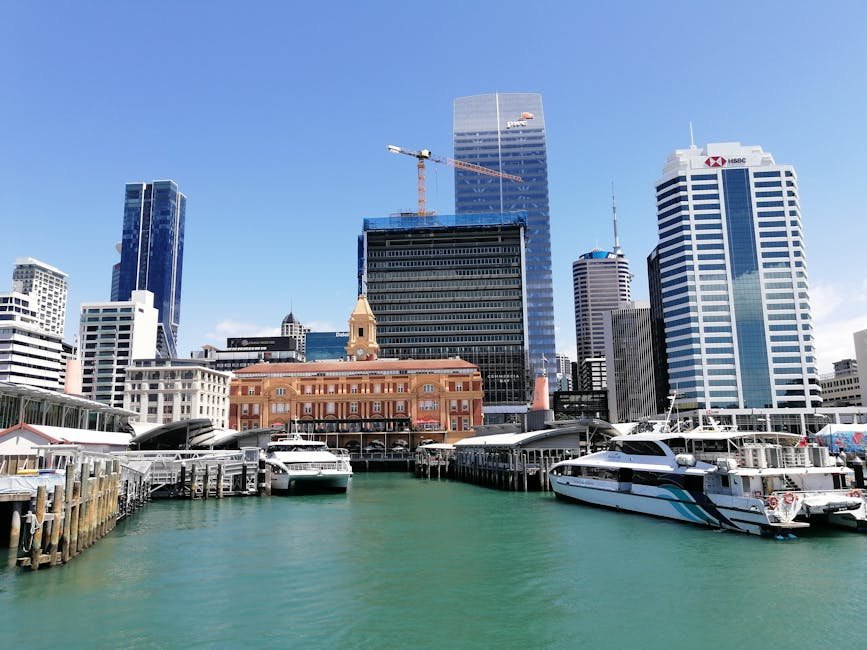
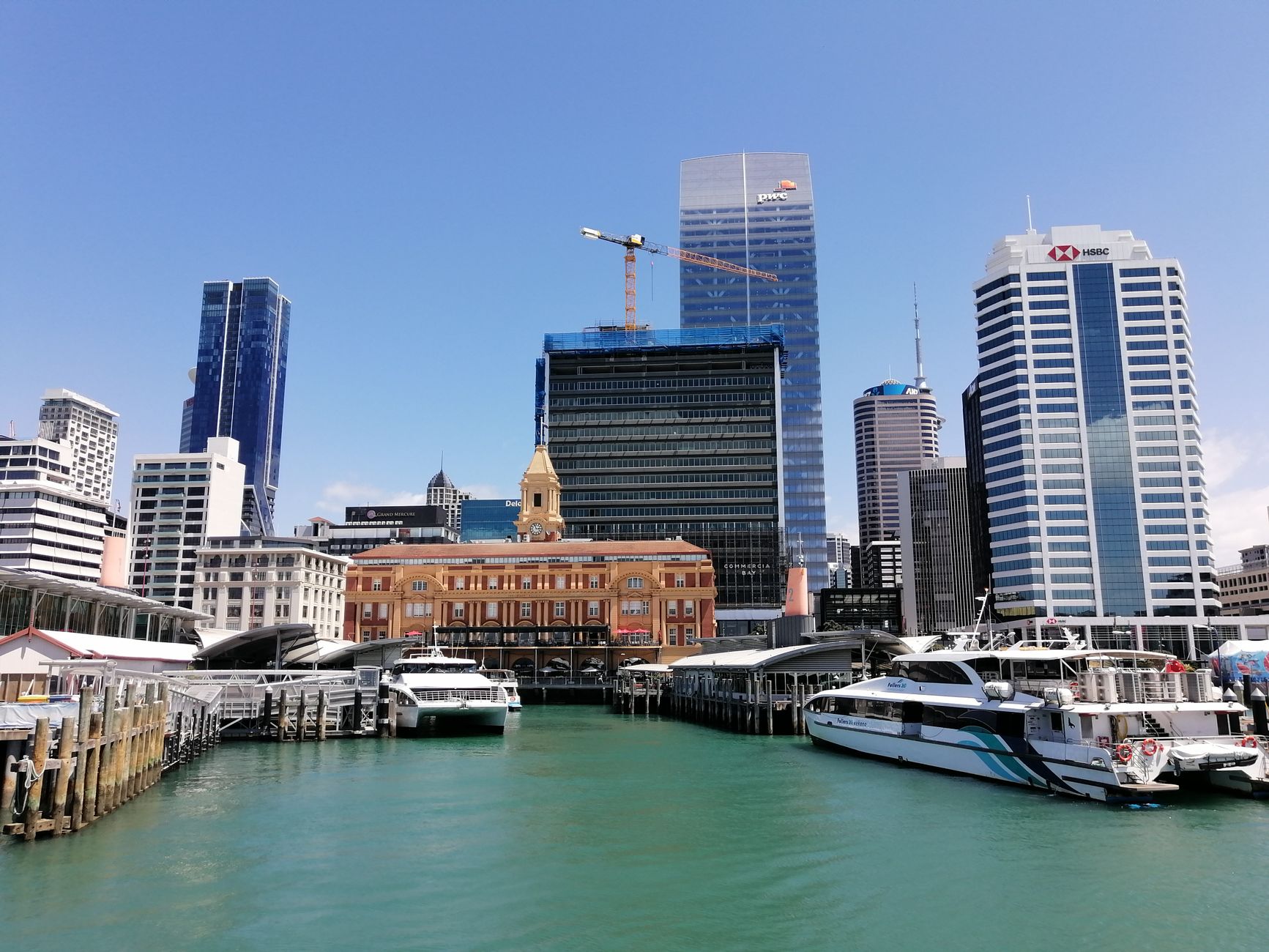
| Ferry Building, 99 Quay St | 1909–1912 | Yes, ground floor and bars | Free |
| Chief Post Office (Waitematā Station) | 1912 | Yes, it is a train station | Free |
| Shed 10, Queens Wharf | 1910 | Only during public events | Varies |
| The Civic, cnr Queen & Wellesley | 1929 | Yes, on a booked tour or at a show | Tour approx. NZ$47–50 |
| St James Theatre, 312–322 Queen St | 1928 | No — building site until 2028 | n/a |
| Auckland Town Hall, 301–317 Queen St | 1911 | Yes, foyer and at concerts | Free to enter foyer |
| Auckland Art Gallery Toi o Tāmaki | 1887 | Yes | Free general admission |
| Auckland War Memorial Museum | 1929 | Yes, but two major galleries shut | NZ$27 overseas adult; Aucklanders free |
| ClockTower, 22 Princes St | 1923–1926 | Yes, in university hours | Free |
| Old Government House, Princes St | 1856 | Grounds yes, interior restricted | Free |
| Highwic, 40 Gillies Ave, Epsom | 1862 | Yes, Wed–Sun | NZ$10 adult, children free |
| Alberton, 100 Mt Albert Rd | 1863 | Yes, check days | NZ$10 adult, children free |
| Ewelme Cottage, 14 Ayr St, Parnell | 1863–64 | Yes, Sundays only | NZ$10 adult, children free |
| Kinder House, 2 Ayr St, Parnell | 1857 | Yes, Wed–Sun midday to 3pm | Free, donation asked |
| St Matthew-in-the-City, Hobson St | 1905 | Yes, most days | Free |
| St Patrick’s Cathedral, Wyndham St | 1885 / 1908 | Yes | Free |
| Holy Trinity & St Mary’s, Parnell | 1897 / 1973 | Yes | Free |
| Northern Club, 19 Princes St | 1867 | No — private members’ club | n/a |
| Hotel DeBrett, 2 High St | c.1925 | Yes, bar and restaurant | Price of a drink |
| Smith & Caughey’s, Queen St | 1929 (Lippincott) | No — closed and for sale | n/a |
| Victoria Park Market chimney | 1905–1908 | Yes, the site is open | Free |
| Esplanade Hotel, Devonport | 1903 | Yes, bar and restaurant | Price of a drink |
| Victoria Theatre, Devonport | 1912 | Yes, buy a film ticket | Cinema ticket price |
What counts as a heritage building in Auckland
Auckland heritage buildings are structures protected either on the Heritage New Zealand Pouhere Taonga List Rārangi Kōrero, which grades places Category 1 for outstanding significance and Category 2 for significance, or in Auckland Council’s Historic Heritage Schedule under the Unitary Plan. The two systems overlap but are separate. Listing recognises value; the council schedule is what actually controls demolition.
That distinction matters more than it sounds. A Category 1 listing from Heritage New Zealand is an honour with limited legal teeth on its own. The council schedule, explained on Auckland Council’s heritage pages, is the thing that stops a bulldozer. Around 215 protected historic heritage places sit inside the city centre alone, which is more than ten per cent of the scheduled places across the whole region, so central Auckland is denser in protected buildings than its reputation suggests.
You can search the national List yourself at Heritage New Zealand Pouhere Taonga — that link goes to the Civic Theatre’s entry, List number 100, which is a decent illustration of the level of detail an entry carries. Every building below that I describe as Category 1 has an entry you can check by number.
The waterfront group: Ferry Building, the Post Office and the red fence
Start at the bottom of Queen Street, because that is where the city started and because everything else is uphill.
The Ferry Building at 99 Quay Street is the best single piece of Edwardian architecture in Auckland and the one visitors photograph without knowing anything about it. Alexander Wiseman designed it, Philcox and Sons built it between 1909 and 1912 for £67,944, and it uses Coromandel granite at the base with sandstone above. It has been a Category 1 historic place since 25 November 1982, List number 102. It is still a working ferry terminal, so you can walk straight through the ground floor for nothing, which is the correct way to see it.
One hundred metres west is the Chief Post Office of 1912, the white Edwardian Baroque pile at the foot of Queen Street. It closed in January 2017 so that City Rail Link tunnels could be driven fourteen metres beneath its marble floor, which is an extraordinary thing to do to a Category 1 building. Auckland Transport finished restoring the façade — the original Crittall steel windows, the Oamaru stone, the domes — in late 2022. The station reopened, was renamed Waitematā in 2023, and on 13 September 2026 the City Rail Link opened and turned it from a dead end into a through station for the first time in its life. If you are reading this before that date, expect disruption; after it, expect a lot more people walking through a heritage building than have for a decade.
East along Quay Street, Shed 10 on Queens Wharf is the last original cargo shed left on the wharf, built in 1910 and restored in 2012. It works as a cruise terminal and an events venue, so entry depends entirely on what is on. If nothing is on, you look at it from outside, which is honest but unsatisfying.
The detail nobody mentions is the red fence. When the port was fenced off for security, a bright red boundary fence snaked along the waterfront with twelve gates, each with its own gatekeeper. Most gates are padlocked now, but the line of red paint survives along Quay Street and you can follow it east past Captain Cook Wharf, built in 1922, towards Mechanics Bay. It costs nothing and it is the closest thing Auckland has to a legible edge between the city and its port.
Queen Street: the good, the shut and the up-for-sale
Queen Street is where Auckland’s heritage story gets uncomfortable. Three of its most important buildings are currently a working theatre, a construction site and an empty department store looking for a buyer.
The Civic
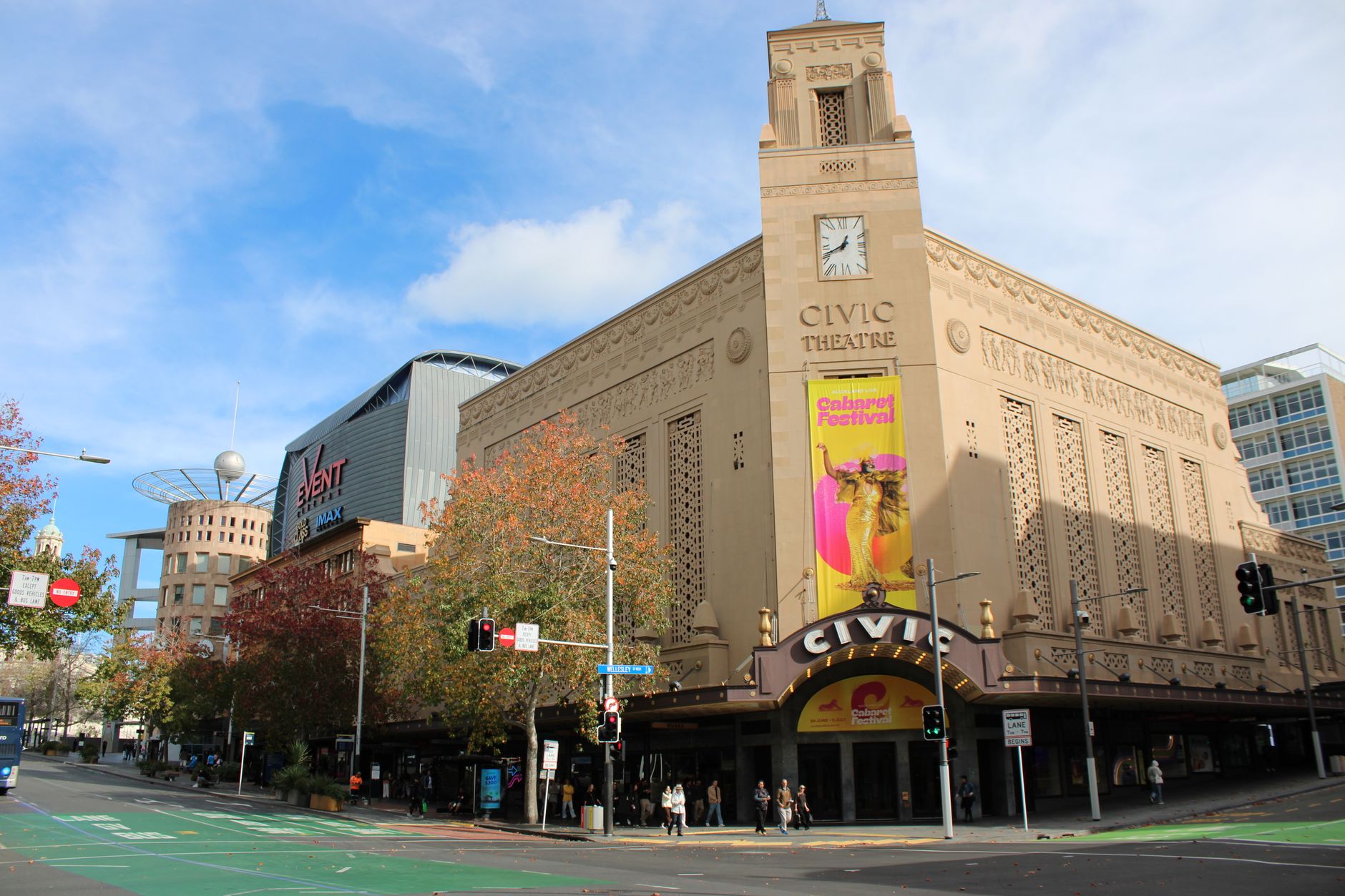
The Civic, on the corner of Queen and Wellesley Streets at 269–287 Queen Street, opened in 1929 and is one of a tiny number of surviving atmospheric theatres anywhere. The auditorium is dressed as an Indian palace garden under an artificial night sky with stars that actually twinkle. It has been Category 1 since 27 June 1985, List number 100. It came within a bad council vote of being lost in the 1990s and was reopened on 20 December 1999, its seventieth birthday, after a restoration reported at around NZ$42 million.
You can get inside two ways. Buy a ticket to any show, or take The Civic Tours, which I confirmed are running on selected dates from 12 March to 3 October 2026 at NZ$46.90 to NZ$49.96. The tour lasts 60 to 75 minutes, caps at eighteen people, and involves roughly 300 steps, so it is not for everyone. Meet in the front foyer fifteen minutes early. It is the only reliable way to see the backstage spaces.
St James Theatre
The St James at 312–322 Queen Street opened as a variety theatre on 5 July 1928 to a Henry Eli White design and is Category 1. It has been closed to the public since a fire in 2007, which makes this the longest-running heritage saga in the city. Every few years a guidebook lists it as an attraction. It is not one. It is a building site.
The current position, verified: the Government and Auckland Council have each committed NZ$15 million, and the target is reopening in 2028, the theatre’s centenary. Work is visibly moving in 2026 — the remains of the original Spanish Mission tower became visible from Queen Street in August 2026 for the first time in more than seventy years, complete with gold detailing and deep reds and blues. Silicone moulds are being taken of the decorative plasterwork. The restored auditorium is expected to seat about 1,480, with a new basement venue underneath.
I have watched this project slip before and I would not book flights around a 2028 opening. But the tower being visible again is the first genuinely encouraging thing to happen to the St James in years, and it is worth standing on the footpath and looking up.
Smith & Caughey’s
Smith & Caughey’s traded on Queen Street for well over a century and closed for the last time in June 2025, weeks earlier than the 31 July date originally announced. The store is gone. The buildings are not, and that is now the story.
The complex includes the Queen Street store, a corner tavern building, and the 1929 building designed by the American architect Roy Alstan Lippincott, which carries the heritage protection. The whole site went to market in 2026 by international expressions of interest closing on 21 April. Reporting at the time was clear that demolition of the primary structures is unlikely and that any development must preserve the existing frontages along Wellesley Street West and Elliott Street. Suggested futures include a boutique hotel or high-end retail. There is now a City Rail Link station almost on its doorstep, which will not hurt.
As of August 2026 I could not confirm a completed sale or a named buyer. Do not plan to go inside. Do walk around the Wellesley and Elliott corner and look at what Lippincott did with it, because he is the same architect who gave the university its ClockTower.
Two office buildings worth two minutes each
Landmark House at 187 Queen Street was built between 1928 and 1930 as the headquarters of the Auckland Electric Power Board, designed by Alva Bartley and T. E. N. Wade, with a ninth floor added in 1933. It is an art deco tower with a corner turret and is Category 1. It is apartments now, so exterior only.
A block down at 101–107 Queen Street, the New Zealand Guardian Trust Building of 1914–1918 is the earliest major work by William Gummer, later one of the most influential architects in the country. Stripped Classical, steel frame encased in concrete, faced in Tākaka marble, and one of Auckland’s first high-rise offices. Also Category 1, also apartments, also exterior only. Both are on the walking route below, thirty seconds apart from the main drag.
The civic group: Town Hall, Art Gallery and two cathedrals
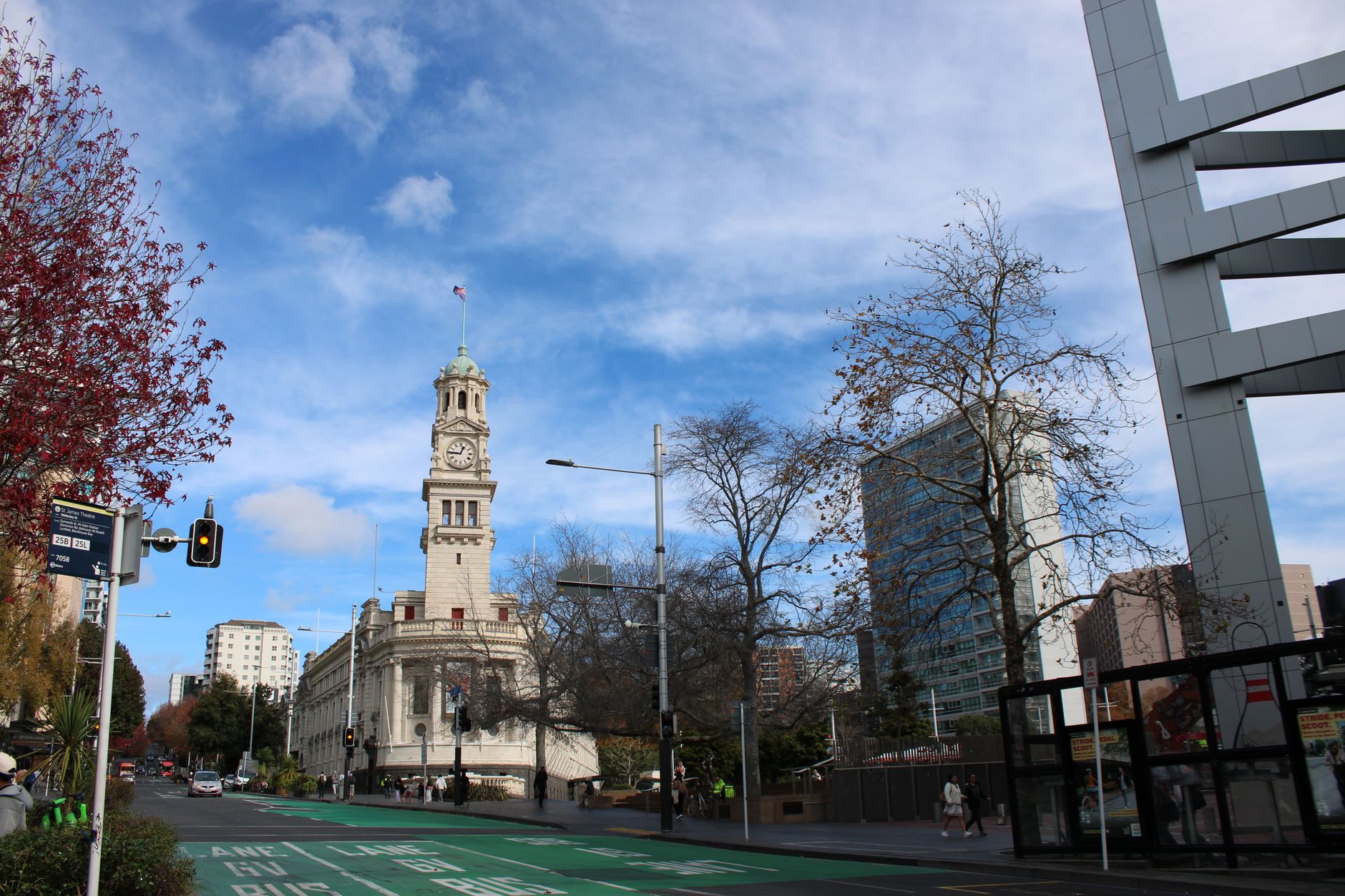
Auckland Town Hall sits on the awkward wedge at 301–317 Queen Street where Queen meets Grey’s Avenue. J. J. and E. J. Clark of Melbourne designed it, it was built between 1909 and 1911, and the Governor-General opened it in 1911 during a week of festivities. The style is Edwardian or Imperial Baroque depending on which authority you read. The Great Hall has some of the best acoustics of any concert hall anywhere and holds the largest musical instrument in the country, a pipe organ well over a century old. The Beatles, the Rolling Stones and The Who all played here.
Here is where I have to be honest. Auckland Live advertises Auckland Town Hall Tours, and plenty of travel pages cheerfully tell you to book one. When I checked in August 2026, the Auckland Live tour listing was still dated 23 January to 11 December 2022, priced NZ$46 to NZ$49. I could not confirm that public tours are currently scheduled. Ring the box office rather than trusting the article that told you to book. In the meantime, the foyer is open during box office hours and a concert ticket gets you into the Great Hall for less than a tour would cost.
Two hundred metres away, the Auckland Art Gallery Toi o Tāmaki opened on 17 February 1888 as the first permanent art gallery in New Zealand, in a French Renaissance-style stone building of 1887 on the corner of Kitchener and Wellesley Streets. The 2011 extension bolted a soaring kauri and glass atrium onto the old fabric and is one of the few modern interventions on an Auckland heritage building that genuinely improved it. General admission is free to everyone, residents and overseas visitors alike, 10am to 5pm daily; touring exhibitions can carry a charge. Our full Auckland Art Gallery visitor guide covers what is actually hanging.
St Matthew-in-the-City at 132–134 Hobson Street is the finest stone church in the city and free to walk into on most days. Frank Loughborough Pearson designed it — not, as several websites have it, some other Frank — and it was completed in 1905 in Oamaru stone, Early English Gothic Revival with an offset tower and tall lancet windows. Category 1, List number 99. Go on a weekday morning and you will likely have it to yourself.
St Patrick’s Cathedral at 43 Wyndham Street has been a Catholic site since 1841 and a cathedral since 1848. Edward Mahoney designed the nave extension of 1884–85, and the present building was opened on 23 February 1908 in front of a congregation of 1,300. Category 1, List number 97. Free, central, and a genuinely calm room in the middle of the office district.
Round the corner, two more that are not open but are worth a look. The Northern Club at 19 Princes Street was completed in 1867 as a hotel, became a gentlemen’s club two years later, and is Category 1 Italianate with rendered brick pretending to be stone. Sources disagree on the architect — some name Edward Mahoney, at least one names James Wrigley, and I could not settle it. It is a private members’ club with over 2,000 members and you are not getting in. Hotel DeBrett at 2 High Street, by contrast, will let anyone in who buys a drink: a mid-1920s Stripped Classical building incorporating brick walls of the roughly 1860 Commercial Hotel, with art deco doors on High Street kept through the 2008 refurbishment. The building sold for NZ$21 million and the hotel operator signed a ten-year lease in 2022.
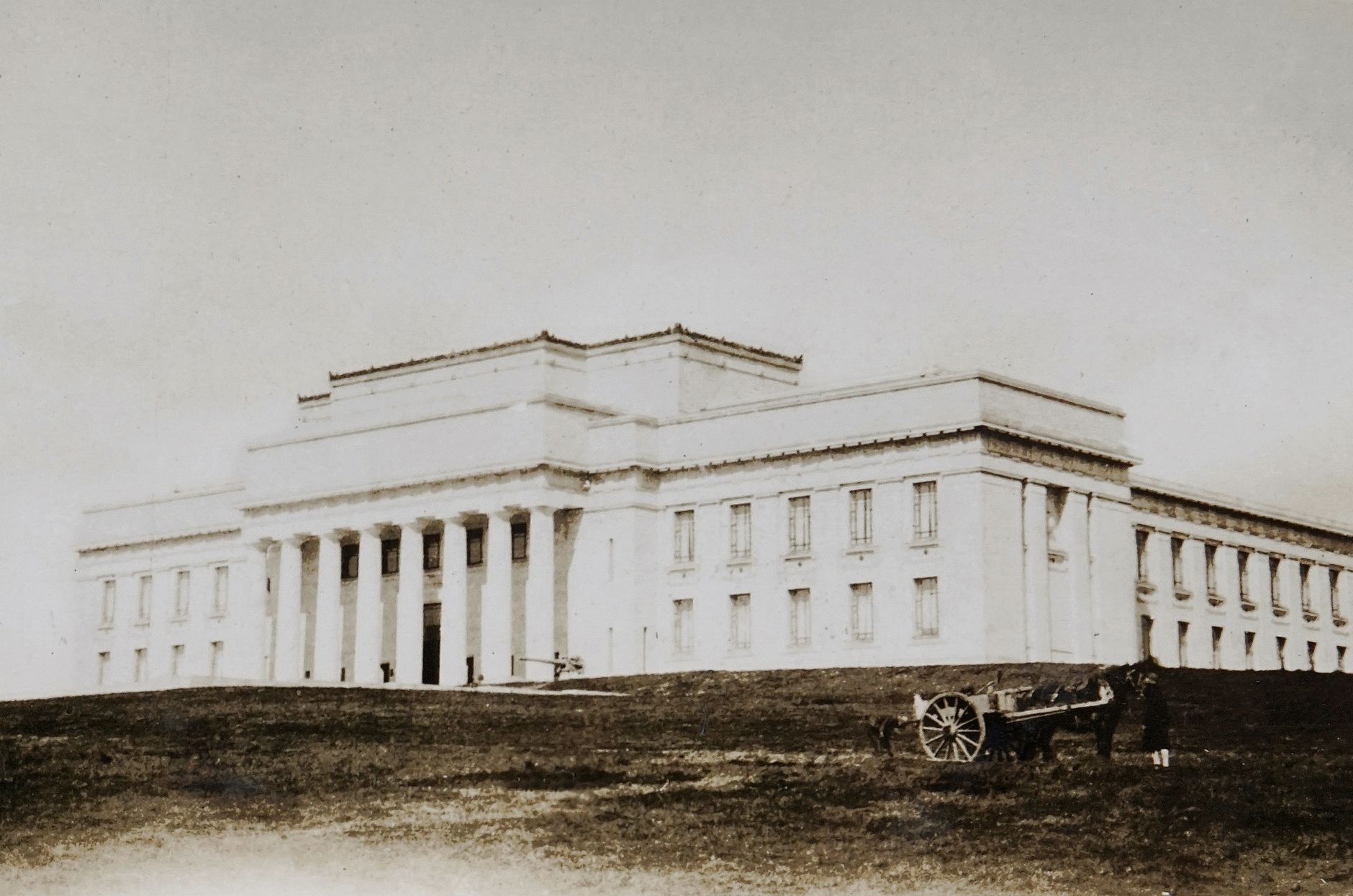
The Domain and the university: museum, ClockTower, Old Government House
The Auckland War Memorial Museum building of 1929 is the most important heritage building in the city and the one you most need current information about. Grierson, Aimer and Draffin won an international competition to design it — all three had served in the First World War — and the neo-classical result won them a New Zealand Institute of Architects gold medal in 1929. Building started in August 1925 and the Governor-General opened it in 1929. The Cenotaph below it, by the same architects, was consecrated on 28 November 1929: Portland stone on a Coromandel granite foundation, modelled on the Whitehall cenotaph. Our Pasifika Auckland guide covers this in more depth.
Now the part the guidebooks keep getting wrong. Asbestos was found in the ceiling of the original 1929 building during scoping work on the air conditioning — remnants of a removal job done in the late 1980s or early 1990s that had been distributed around the building. The museum shut on 10 May 2025. Most of it reopened on 3 June 2025. Te Marae Ātea Māori Court and the Pacific galleries did not, and as of August 2026 they are still closed, with reporting tying their reopening to a wider centenary redevelopment that could run to 2029.
If you are coming to Auckland specifically to see the Māori and Pacific collections in that building, do not. There is no confirmed reopening date. Our guide to the museum’s Māori exhibits and what is currently accessible goes into what remains on view, The Domain around it is free and entirely unaffected.
Admission while galleries are closed sits at a discounted NZ$27 for an overseas adult, NZ$13.50 for children aged 5 to 15, under-fives free, with a family pass around NZ$72. Auckland residents enter free with proof of address; other New Zealanders are asked for a donation. Check the museum’s own hours and admission page before you go, because that discount exists precisely because the building is not whole.
Ten minutes downhill, the University of Auckland ClockTower at 22 Princes Street turned one hundred in March 2026. Roy Lippincott and Edward Billson won a 1921 competition against 44 entries and the building went up between 1923 and 1926 in what is usually called Perpendicular Gothic, except that Lippincott carved New Zealand into it: kea, kākā and ponga fronds in the stonework instead of European foliage. Category 1. It is a working university building, free to walk into during teaching hours, and the entrance carving repays five minutes of standing still.
Beside it on Princes Street is Old Government House, completed in 1856 to a design by William Mason and the oldest surviving building of consequence in the central city. It is built of kauri, carefully worked to look like stone from a distance, which is the most colonial-Auckland thing imaginable. Category 1, List number 105. It belongs to the university now and the interior is largely reserved for staff, but the grounds are open and free and are one of the better places in the CBD to sit down. For how these buildings fit the wider settlement story, see our Auckland colonial history guide.
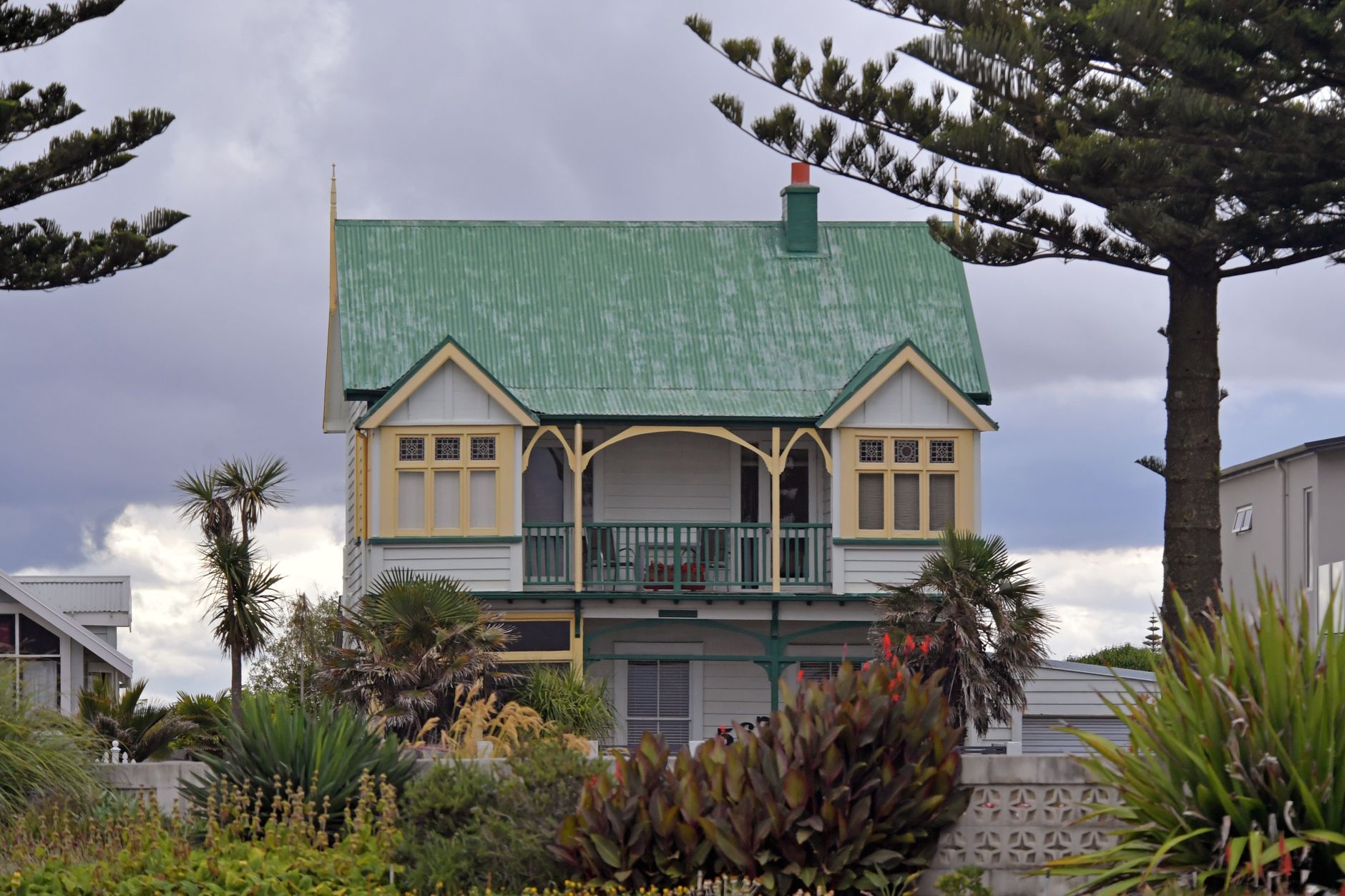
The historic houses: where you actually get inside
This is the part of Auckland heritage that works best and gets written about least. Three Heritage New Zealand house museums, all with real interiors, all cheap.
Highwic at 40 Gillies Avenue, Epsom, was built in 1862 for the landowner Alfred Buckland and extended in 1873 using an American pattern book. It is one of the finest timber carpenter Gothic houses in the country: steep gables, timber tracery, and the domestic chaos of a man who had 21 children. Category 1. Adults NZ$10; accompanied children up to 16 are free, maximum four per paying adult. Open Wednesday to Sunday, 10.30am to 4.30pm, with last recommended entry at 3.45pm. The practical note that matters: the address is Gillies Avenue but the recommended entrance is off Mortimer Pass.
Alberton at 100 Mount Albert Road was built by Allan Kerr Taylor in 1863 and grew from a farmhouse into a rambling house with verandahs and towers, home to the Kerr Taylor family and their many daughters. Adults NZ$10, children 17 and under free, maximum four per paying adult, and free for Heritage New Zealand members and affiliated international organisations. I could not confirm Alberton’s exact current opening days from a primary source, so ring ahead rather than turning up.
Ewelme Cottage at 14 Ayr Street, Parnell, was built in 1863–64 for the Reverend Vicesimus Lush and is the most atmospheric of the three, right down to nineteenth-century wallpaper. It is open Sundays only, 10.30am to 4.30pm, NZ$10 for adults with accompanied children under 18 free. It reopened on Sunday 14 June after a two-month restoration by Auckland Council contractors. All three usually open free on Waitangi Day, which is a genuinely good deal if you are here on 6 February.
Two doors along at 2 Ayr Street, Kinder House was built in 1857, commissioned by Bishop Selwyn and designed by Frederick Thatcher in local volcanic stone. It is open Wednesday to Sunday from midday to 3pm, entry is free and a donation is requested. Between Kinder and Ewelme you can do two nineteenth-century houses in an hour for ten dollars total. The Parnell neighbourhood guide covers where to eat afterwards.
Also in Parnell, Holy Trinity Cathedral at 446 Parnell Road is worth going in for one reason above all others: St Mary’s, the wooden church beside it. Benjamin Mountfort designed it and it was completed in 1897, and at over 50 metres long it is the largest wooden Gothic church in the world. On 6 March 1982 the police closed Parnell Road for the day and the entire building was moved across the road and turned ninety degrees onto its present site. Category 1 since 1981. Free to visit, and the contrast between the Victorian timber and the modern cathedral next to it is the whole argument about heritage in one courtyard.
Out at 40–44 Tamaki Drive in Mission Bay, the Melanesian Mission House of 1859 is Tudor Revival in local basalt and Category 1. Heritage New Zealand owns it but leases it out, and it has been seismically upgraded and reopened as a function and events venue with a restaurant in a modern pavilion alongside. Public access is effectively exterior only unless you are eating there. Its history is bleak: it opened as a school for Melanesian students and fourteen of them died in a dysentery epidemic in 1863–64, after which the mission moved to Norfolk Island.
Victoria Park Market and the chimney
At 210 Victoria Street West stands the strangest heritage building in Auckland: a rubbish incinerator. An outbreak of bubonic plague in the colonies prompted the city to build a “destructor” furnace in 1905, and brick buildings went up on the site between 1905 and 1918 along with a chimney 38 metres tall. A power generator was added in 1907, finished in 1908, found inadequate, and shut down in 1913.
The complex is Category 1 and has been a market and retail village since the 1980s, seismically strengthened and refurbished, with the chimney restoration alone reported at NZ$600,000 — workers abseiled down the inside to remove tonnes of collapsed brick. The site is open and free to wander. The retail mix has churned repeatedly over the years, so treat any list of specific shops with suspicion, including mine.
Devonport: the ferry, the pub and the oldest cinema in the country
Twelve minutes on the ferry from the Ferry Building gets you to a village that kept more of its Victorian and Edwardian streetscape than anywhere in the isthmus, largely because the harbour kept the developers on the other side of it.
The Esplanade Hotel at 1 Victoria Road is the building you see from the ferry: built in 1903, ornate facade, prominent corner site right on the waterfront, and listed by Heritage New Zealand. Few large hotels from the turn of the century survive in New Zealand at all, which is what makes it significant rather than merely handsome. It still operates as a hotel with seventeen rooms plus a bar and restaurant, so you can walk in and buy a beer and look at the ceiling, which is the cheapest heritage access in Auckland.
Up the road at 48–56 Victoria Road, the Victoria Theatre is the real prize. Built in 1912 for the American John Leon Benwell, originally seating 965 in the silent film era, it is the oldest surviving purpose-built cinema in New Zealand and is generally described as the oldest in the Southern Hemisphere. It was refurbished in 2010 and is run by the Victoria Theatre Trust, which has a long-term goal of a fuller heritage restoration. It still shows films. Buy a ticket to whatever is on and you are inside a working 114-year-old cinema for the price of a movie, which beats any guided tour in the city on value. Our Devonport day trip guide has the ferry timetable detail.
The ones we lost
Any honest account of Auckland heritage buildings has to include the ones that are not there, because they explain the defensiveness you will hear from anyone who works in this field here.
Partington’s Mill was built in Symonds Street in 1851 by the engineer and millwright Charles Partington, six storeys and 24.3 metres tall, made of bricks from local clay, standing on the Karangahape Road ridgeline where it was visible from most of the young town. It was Auckland’s oldest and best-known landmark. Charles’s son Joseph ran it until 1941.
Joseph had gifted the windmill to the city in his will so that it would be preserved. When he died in 1941 the will could not be found. The Supreme Court declared him intestate, the mill passed to the extended family, and the family sold it. In 1945 the council helped set up an Old Windmill Preservation Society to move it elsewhere, but public fundraising fell short and the idea died. In 1947 the owners told the council they intended to demolish and offered it the chance to salvage the materials. The council declined on cost. The mill came down in 1950. Its loss was a direct catalyst for the creation of the National Historic Places Trust in 1955 — the body that became Heritage New Zealand Pouhere Taonga. A hotel stands on the site now.
His Majesty’s Theatre and Arcade at 142 Queen Street, built in 1902 by the Australasian impresario J. C. Williamson, is the modern equivalent. It closed on 21 December 1987. Demolition contractors moved in overnight on 23 and 24 December, hours before a preservation order could be actioned, at the one moment of the year when nobody was in an office to stop them. Protesters got a council inspector out of bed at 1am. The permit was granted on 31 December, the stage came down on 13 January 1988, and by around 14 January it was past saving. Twenty-nine people were arrested for trespass and obstruction. Auckland lost a lavish 1902 auditorium four minutes’ walk from the Civic and gained nothing anyone remembers.
That is the context for everything above. When people here are precious about a chimney or a facade, this is why.
A two-hour self-guided heritage walk through central Auckland
This route strings the central buildings together, runs roughly two hours at a normal pace with stops, and climbs about 70 metres. Do it uphill, from the water to the university, so the hard part comes when you are fresh. Wear something you can walk in; Queen Street is steeper than it looks in photographs.
- Start: Ferry Building, 99 Quay Street. Walk through the ground floor, out the back onto the wharf, and look at the sandstone from the water side. Ten minutes.
- East 150m to Queens Wharf and Shed 10. The 1910 cargo shed on your left. If an event is on you can go in; if not, carry on. Five minutes.
- Back west to the Chief Post Office. Cross Quay Street at the lights by Queen Street. Walk through Waitematā Station and out the Queen Street side to see the Edwardian Baroque façade properly. Ten minutes.
- Up Queen Street. Guardian Trust Building at 101–107 on your right, then Landmark House at 187 with its corner turret. Look above the shopfronts the whole way; there is more surviving 1900–1930 fabric on Queen Street than anyone expects. Fifteen minutes.
- Wellesley Street corner. Smith & Caughey’s on your right at 253–261 — walk one block west along Wellesley to Elliott Street to see the Lippincott frontages. Then back to Queen. Ten minutes.
- The Civic, corner of Queen and Wellesley. If you have booked a tour, this is where it starts. Otherwise look at the exterior detailing and the marquee. Five minutes.
- Aotea Square and the Town Hall at 301–317 Queen. Walk into the foyer if the box office is open. Across the road at 312–322 is the St James hoarding; look up for the Spanish Mission tower. Fifteen minutes.
- Cut east on Wellesley Street to the Auckland Art Gallery, corner Kitchener. Free entry, and a decent toilet stop. Twenty minutes minimum if you go in.
- Up Kitchener Street to Princes Street. Northern Club at 19 on your right, ClockTower at 22 opposite, Old Government House in its grounds behind. Sit down in the grounds. Twenty-five minutes.
- Optional 15-minute add-on: from the Art Gallery, head west along Wellesley to Hobson Street for St Matthew-in-the-City, or south-east to Wyndham Street for St Patrick’s. Both free, both worth it, neither on the direct line.
If you would rather have someone who knows the buildings talk you through them, our roundup of the best walking tours in Auckland covers the guided options, several of which run a heritage-specific route.
Frequently asked questions
What is the oldest building in Auckland city centre?
Old Government House on Princes Street, completed in 1856 to William Mason’s design, is the oldest surviving public building of note in the central city. It is built of kauri worked to look like stone. Kinder House in Parnell followed in 1857 and Highwic in 1862. Nothing European in central Auckland is older, because the city itself only dates from 1840.
Can you go inside the Civic Theatre without seeing a show?
Yes, on The Civic Tours, which I confirmed running on selected dates from 12 March to 3 October 2026 at NZ$46.90 to NZ$49.96. The tour is 60 to 75 minutes, capped at eighteen people, and involves around 300 steps with limited seating. Book ahead through Auckland Live and meet in the front foyer fifteen minutes before the start time.
Is the Auckland Museum fully open in 2026?
No. Asbestos found in the 1929 building closed the museum on 10 May 2025. Most of it reopened on 3 June 2025, but Te Marae Ātea Māori Court and the Pacific galleries remain closed as of August 2026, with no confirmed reopening date and reporting suggesting a wait tied to a redevelopment running towards 2029. Admission is discounted accordingly.
Has the St James Theatre reopened?
No. It has been shut to the public since a fire in 2007 and is an active construction site. The Government and Auckland Council have each put in NZ$15 million and the stated target is a 2028 reopening for the theatre’s centenary. Work is visibly progressing — the original Spanish Mission tower reappeared from behind cladding in August 2026 — but treat 2028 as a hope, not a booking.
How much does it cost to visit Highwic, Alberton and Ewelme Cottage?
NZ$10 for an adult at each, with accompanied children free to a maximum of four per paying adult, and free entry for Heritage New Zealand members. Highwic opens Wednesday to Sunday 10.30am to 4.30pm, Ewelme Cottage Sundays only at the same hours. I could not confirm Alberton’s current days from a primary source, so phone before you drive there.
Which Auckland heritage buildings are free to enter?
The Ferry Building ground floor, Waitematā Station in the old Chief Post Office, the Town Hall foyer, Auckland Art Gallery, the University ClockTower during teaching hours, the grounds of Old Government House, Kinder House, St Matthew-in-the-City, St Patrick’s Cathedral, Holy Trinity and St Mary’s in Parnell, and the whole Victoria Park Market site.
What is the difference between a Category 1 listing and the council heritage schedule?
Heritage New Zealand’s List Rārangi Kōrero recognises significance, grading places Category 1 or Category 2, but a listing alone carries limited legal force. Auckland Council’s Historic Heritage Schedule in the Unitary Plan is the instrument that actually restricts demolition and alteration. A building can be nationally celebrated and still legally vulnerable if it is not scheduled.
Is Smith & Caughey’s building going to be demolished?
Almost certainly not. The store closed in June 2025 and the site went to market in 2026, but the 1929 Lippincott building is heritage protected and reporting on the sale was explicit that demolition of the primary structures is unlikely and that the Wellesley Street West and Elliott Street frontages must be preserved. A hotel or retail conversion looks more likely. I could not confirm a final buyer.
Final take
The pattern I kept hitting while checking this is that Auckland’s best heritage access is cheap or free, and its most heavily promoted heritage access is either expensive or currently unavailable. Ten dollars gets you a full Victorian house at Highwic. Nothing at all gets you into St Matthew-in-the-City, the ClockTower, the Art Gallery and the Ferry Building. Meanwhile the museum is missing two of its most significant galleries, the St James is a hoarding, and the Town Hall tour that half the internet tells you to book has a listing that has not been updated since 2022.
If you only have half a day, do the walk above and pay for exactly one thing: The Civic tour. It is the single building where the interior is the entire point and where you cannot see it any other way. If you have a second day, get the ferry to Devonport, drink something at the Esplanade and watch a film at the Victoria, which at 114 years old is doing the job it was built for. That combination will teach you more about this city than any museum currently can. The Auckland CBD guide covers where to base yourself for it.
And keep Partington’s Mill in mind. Auckland lost its most recognisable landmark in 1950 because a will went missing and a council would not pay to save the bricks, and it lost His Majesty’s Theatre in 1988 to contractors working through Christmas. The buildings on this page are here because enough people fought for them at the right moment, and several of them nearly went the other way. That is not a sentimental reading; it is what the record shows. For the fuller version of that record, start with the Auckland culture, history and heritage guide.
Last updated: August 2026. Opening hours, admission charges and restoration status change; confirm directly before you travel.
Photo credits
- Photo: New Zealand via Pexels
- Photo: Subhan Dodangoda via Pexels
- Photo: Subhan Dodangoda via Pexels
- Photo: Suzy Hazelwood via Pexels
- Photo: Chen Te via Pexels
- Photo: quang vinh via Pexels