One Tree Hill Auckland: History, Walks & Views (2026)
Complete 2026 One Tree Hill Auckland guide — Maungakiekie summit walk, sheep at Cornwall Park, the obelisk, history and the perfect half-day plan.

This article contains advertising. Our booking links are routed through a partner that adds commission tracking automatically, so if you book through one we earn a commission from the provider, at no extra cost to you. It never affects what we recommend. Affiliate disclosure
One Tree Hill — Maungakiekie — is a 182-metre volcanic cone ten minutes south of the Auckland city centre, wrapped in two adjoining parks that together make roughly 540 acres (220 hectares) of free public land. Cornwall Park’s 425 acres are run as a working farm by the Cornwall Park Trust Board; the 118-acre Maungakiekie One Tree Hill Domain next door is owned by the Tāmaki iwi collective and governed by the Tūpuna Maunga Authority. Sheep and cattle graze the paddocks, the summit carries an obelisk and a view over both harbours, and the terraces cut into the slopes are what remains of the largest pā on the isthmus. This 2026 guide covers the history, the walks, the gates and hours, and how to plan a visit that does not end at a locked gate. Our Auckland Domain guide covers this in more depth.
| Detail | What to know |
|---|---|
| Māori name | Maungakiekie, the mountain of the kiekie vine |
| Height and age | 182m; erupted about 67,000 years ago |
| Cost | Free – entry, parking and the summit walk |
| Gates | Cornwall Park’s vehicle gates open at 7am and lock at 6pm, every day |
| Summit access | Walking only; no private vehicles since 2018 |
| Walk time | 20 to 30 minutes up from Cornwall Park; the loop road is 2.9km |
| Mobility access | Phone Cornwall Park on 09 379 1340 for the gate code |
| The farm | About 600 sheep and 60 cattle; lambing early August to 10 September |
| Dogs | Welcome on a lead; restricted in signposted paddocks during lambing |
| Time needed | Two to three hours, or half a day with lunch |
Quick Facts: One Tree Hill / Maungakiekie
- Height: 182m above sea level — the second-highest volcanic cone on the Auckland isthmus, after Maungawhau Mt Eden at 196m
- Type: Scoria cone volcano
- Age: ~67,000 years old
- Status: Dormant — won’t erupt again, but the wider Auckland Volcanic Field is active
- Cultural significance: Sacred to Tāmaki Māori, governed by the Tūpuna Maunga Authority
- Access: Free, walking and cycling, no vehicle access to the summit
- Surrounding park: Cornwall Park, 425 acres (172ha), free and open to everyone; with the adjoining 118-acre Domain it comes to about 540 acres
Why One Tree Hill Is a Must-Visit
Five reasons One Tree Hill is essential Auckland:
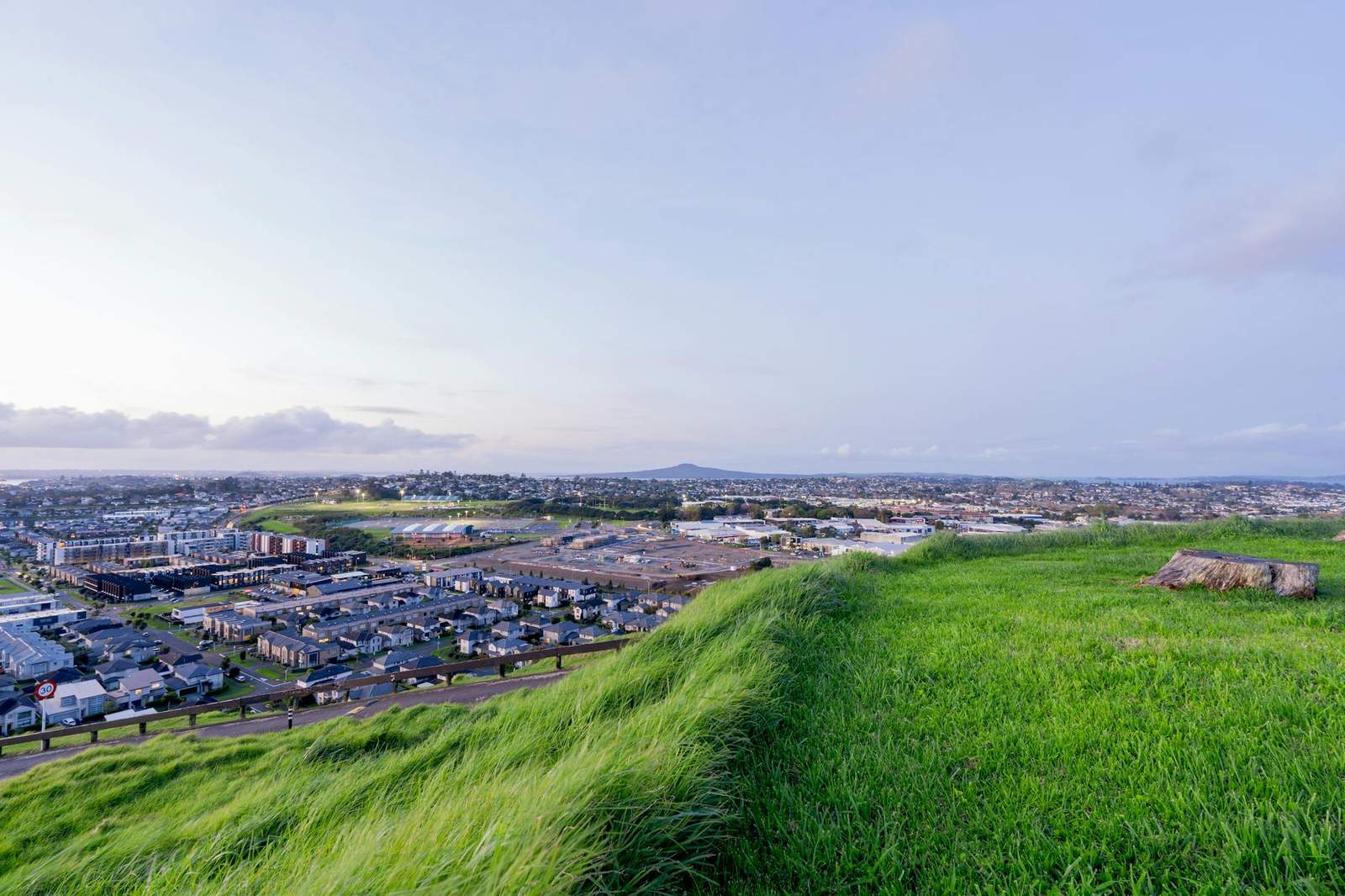
- The summit views — 360-degree panorama of Auckland, the harbour, Rangitoto, and the Hauraki Gulf
- Cornwall Park — 540 acres of public parkland with grazing sheep, picnic spots, and ancient trees
- The terraced earthworks — visible remnants of the Tāmaki Māori pā (fortified village)
- The summit obelisk — striking memorial to Sir John Logan Campbell, the "father of Auckland"
- Family-friendly — sheep, lambs, picnic spaces, gentle walks, café
How to Get to One Tree Hill
- Drive from CBD — 15 minutes via Greenlane West, free parking inside Cornwall Park
- Bus — Outer Link or 30 from Britomart, 25 mins, NZ$3.50 with HOP card
- Train + walk — Train to Greenlane Station, 15-min walk
- Auckland Explorer Bus — hop-on hop-off tourist bus stops at Cornwall Park
- Bike — Cornwall Park is bicycle-friendly, lock racks at the carpark
Getting the gates right matters more than anything else here. Cornwall Park’s vehicle gates open at 7am and are locked at 6pm every day of the year, weekends and public holidays included, so an evening visit means walking in and timing your exit. There are two vehicle entrances: the Green Lane West main gate, the only way into the main part of the park and the eateries, which feeds the one-way road through to Manukau Road; and the Kenneth Myers gate off Manukau Road, which reaches the archery car park and the southern end but does not connect through. Parking is free and spread along the drives rather than gathered in one car park, and it fills from mid-morning on fine weekends.
The Summit Walk
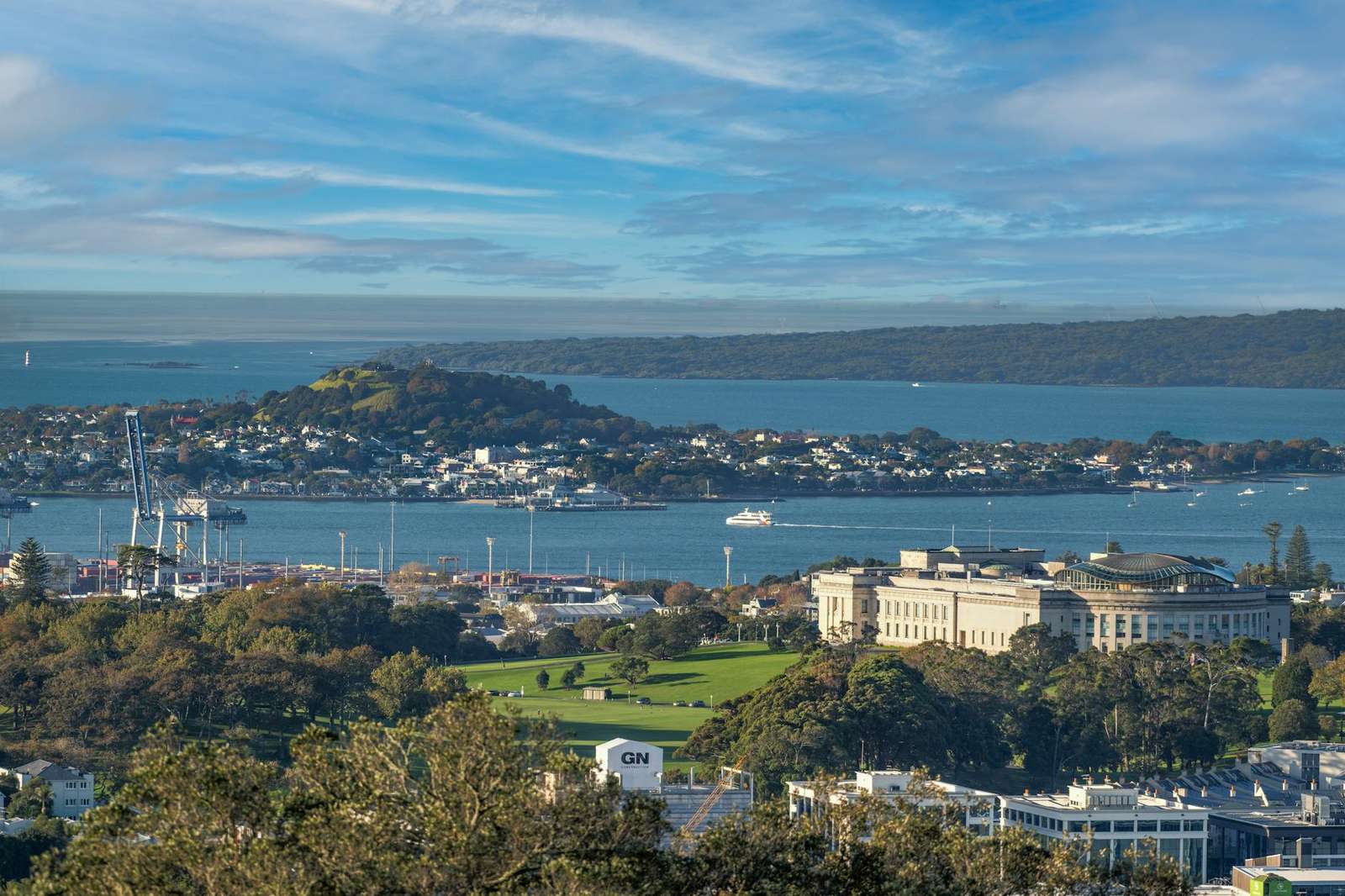
The walk to the summit takes about 15–25 minutes from the Cornwall Park carpark. Two main routes:
- Direct path — paved, gentle gradient, 15 minutes one-way, suitable for prams and most fitness levels
- Sheep-grazing meander — through the parkland past sheep, longer (25–30 mins), more scenic
Private vehicles have been off the summit since 2018, when the Tūpuna Maunga Authority closed the road for cultural reasons and for pedestrian safety; after-dark access had already ended in 2008. What is left is a genuinely quiet summit. In May 2026 a new link to the tihi track opened, with boardwalks and stairs giving a more direct route up from Cornwall Park while taking pressure off older paths that had eroded badly into archaeological features.
The numbers: 20 to 30 minutes on foot from the middle of Cornwall Park to the tihi, and 2.9km around the loop road, about 40 minutes at a stroll. If you have limited mobility you can still drive up — phone 09 379 1340 for the gate code. Our guide to Auckland’s volcanic field explains how 50-odd cones ended up under a city.
The Summit Obelisk
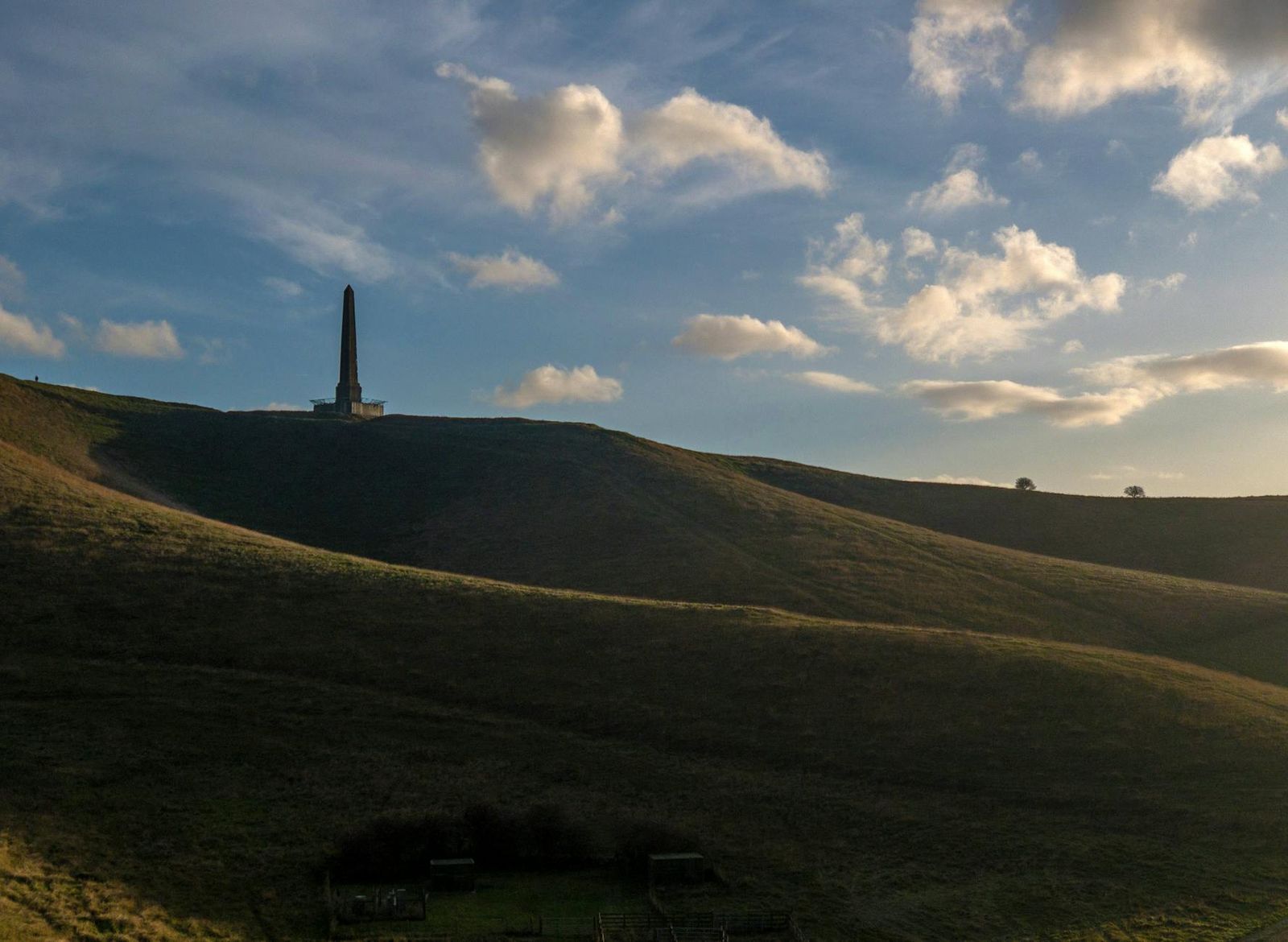
The stone obelisk that dominates the summit was designed by Richard Abbott and completed in 1940, paid for by a £5,000 bequest from Sir John Logan Campbell (1817–1912), the Scottish-born settler usually called the father of Auckland. Campbell gifted his One Tree Hill Estate to the public in 1901 and the park opened to visitors on 26 August 1903. If you want more on that side of things, see our Auckland hidden gems guide.
A bronze Māori warrior stands in front of it, and Campbell’s grave — a plain granite slab with a bronze wreath — lies in the middle of the viewing platform.
The monument has a stranger history than the plaques suggest. Campbell intended it as a memorial to Māori, whom he, like many Pākehā of his generation, expected to die out. By the time the tower was finished that assumption had aged badly and there was real objection to the word memorial. The opening was then postponed through the Second World War, because tikanga holds that a monument should not be opened in a time of bloodshed, and the ceremony finally took place on 24 April 1948, led by the Māori King, Korokī.
Why "One Tree" Hill?
The English name comes from a single tree standing near the tihi when the colonial town was founded. Accounts differ on what it was — two identify it as a pōhutukawa, others as a tōtara — and a settler cut it down in 1852. In 1875 John Logan Campbell planted a young tōtara on the summit with Monterey pines around it as a windbreak. The tōtara did not survive the exposure; two pines did, and after one was attacked in 1960 a single Monterey pine was left as the one tree.
That pine was attacked with a chainsaw on 28 October 1994 by the activist Mike Smith, in protest at Crown treatment of Māori, and again in October 2000. It could not be saved and was taken down on 26 October 2000; the chainsaw is now in Te Papa’s collection. For 16 years the hill had no tree. On 11 June 2016 the Tūpuna Maunga Authority held a dawn ceremony on the summit and planted nine saplings — three tōtara and six pōhutukawa, grown from parent trees on the maunga — inside a shelterbelt of native shrubs. Arborists will thin them over the coming decades, and the strongest survivor becomes the next one tree.
Cornwall Park: 540 Acres of Free Parkland
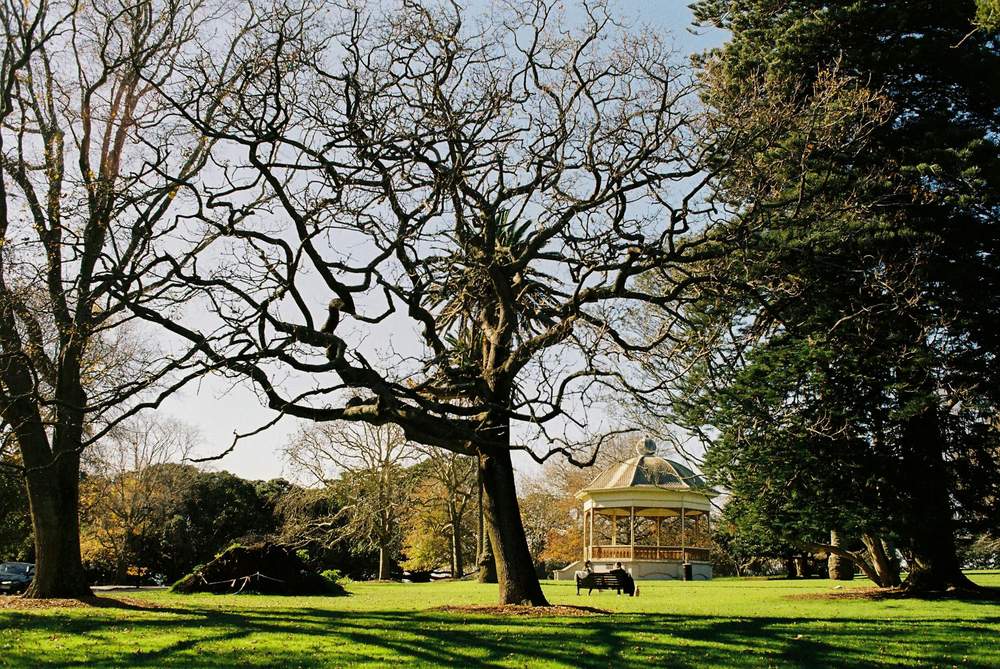
Cornwall Park is the surrounding parkland that makes One Tree Hill so special. Donated by Sir John Logan Campbell to the people of Auckland in 1901, the park is run as a working farm with grazing sheep alongside public access. Features include:
- Sheep and cattle — a working flock of about 600 sheep and 60 cattle; lambing runs from early August to 10 September and calving from 17 July to mid-August
- Three eateries — the Cornwall Park Bistro, the Cornwall Park Cafe and The Creamery for ice cream; hours are listed at cornwallparkeateries.com
- Picnic spaces — shaded under giant pohutukawa, kauri, and Norfolk pines
- Acacia Cottage — built in 1841 and moved into the park in the early 1920s; the oldest surviving wooden cottage in Tāmaki Makaurau, and you can look through it any day from 7am to dusk
- Huia Lodge Discovery Hub — free interactive displays in the 1901–03 lodge, open 10am to 4pm most days and from midday on Wednesdays, with a small gift shop and seasonal exhibitions
- Walking and cycling tracks throughout the park
- Playground — there is no playground inside Cornwall Park itself; the nearest is next door in the Domain, beside Stardome
- Public toilets at multiple locations
The gates open at 7am and lock at 6pm daily. Dogs are welcome on a lead everywhere in the park — there are no off-lead areas, and access is restricted in signposted paddocks during lambing and calving between 17 July and 10 September. Picnics are encouraged, though groups over 30 need to register first, and there are three free barbecue areas, two gas and one wood-fired. What is not allowed: drones, metal detecting, pegs in the ground, and commercial activity of any kind, including paid tours and filming.
The Tāmaki Māori Heritage
Maungakiekie was one of the largest pā (fortified Māori villages) in pre-European NZ, a cornerstone of Auckland’s Māori history and heritage. The terraced earthworks visible on the cone’s slopes are remnants of the village’s defensive ramparts, kūmara storage pits, and house platforms. At its peak, Maungakiekie housed several thousand inhabitants from the Tāmaki tribes.
In 2014, the cone was transferred from Auckland Council to the Tūpuna Maunga Authority — a co-governance body of Tāmaki tribes and Auckland Council. The Authority now manages the maunga as a sacred site while keeping it accessible to the public. Information panels explain the cultural significance.
The terraces have names. They are known as Ngā Whakairo a Tītahi, the carvings of Tītahi, after the Ngāti Awa chief credited with shaping them in the seventeenth century, and the summit is also called Te Tōtara-i-āhua, the tōtara that stands alone. Under the Waiohua confederation and its paramount chief Kiwi Tāmaki this was the seat of power on the isthmus, holding a population estimated at up to 5,000 across the cone and the kūmara gardens running south towards Onehunga. After Waiohua’s defeat by Te Taoū in the 1740s, the chief Tuperiri built a pā called Hikurangi below the summit.
The 2014 settlement returned 14 tūpuna maunga across Auckland, this one included, to Ngā Mana Whenua o Tāmaki Makaurau, a collective of 13 iwi and hapū, to be held for the common benefit of everyone in the city. If you would rather have that explained by mana whenua than by a sign, our guide to Māori cultural experiences in Auckland covers the guided options. What that means for a visitor is simple: this is a sacred site, not a lookout. Stay on the formed tracks, do not fly a drone, do not metal-detect, and treat the tihi the way you would treat a marae. Our guide to Auckland’s Māori history and culture has more.
Sheep at Cornwall Park
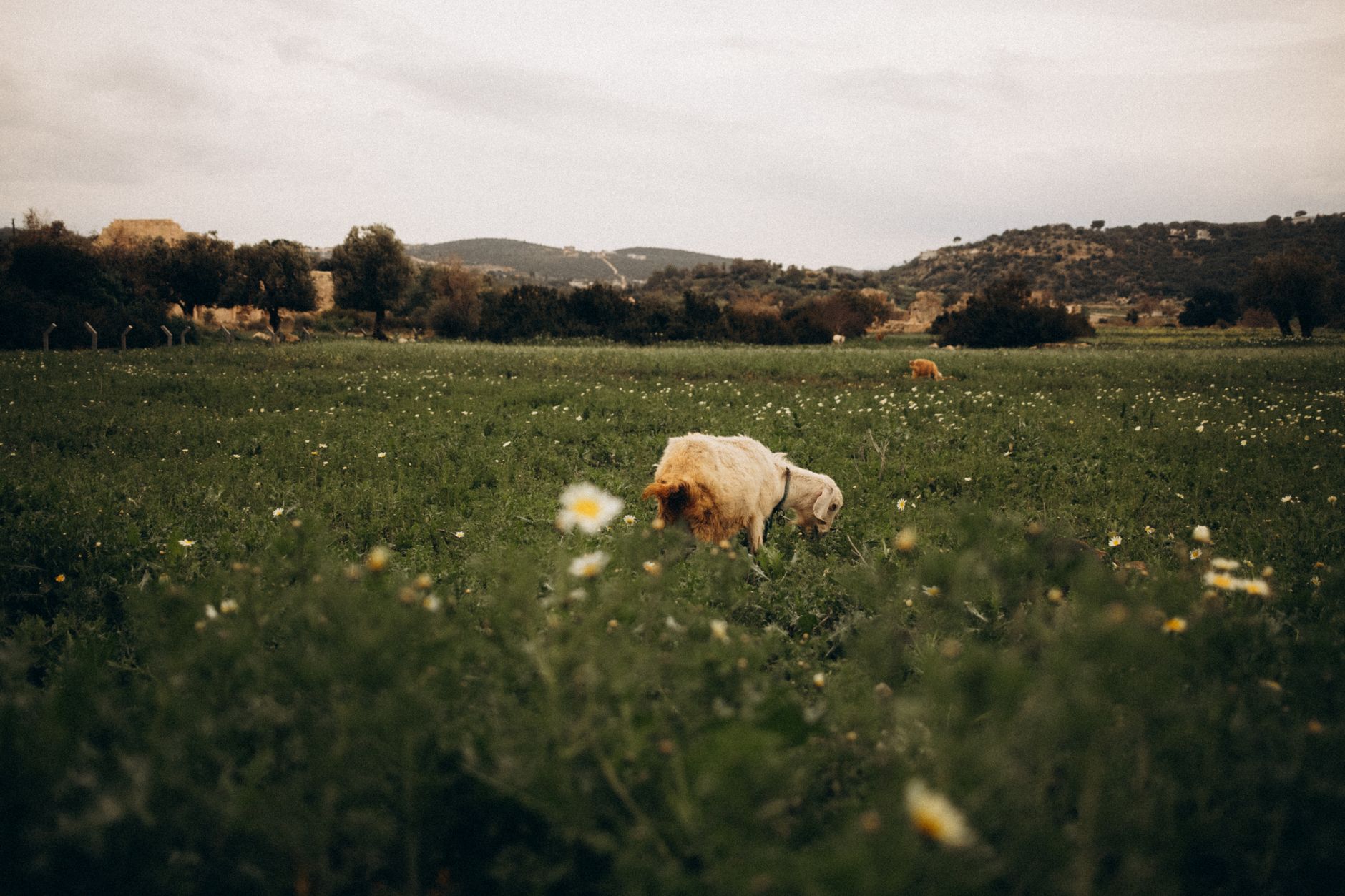
The farm is real, not decorative. Cornwall Park runs about 600 sheep and 60 cattle across the paddocks, rotated so there is always grass, and shears twice a year in May and December. Lambing starts at the beginning of August and runs to 10 September; calving is from 17 July to mid-August. That makes late winter and early spring the best window for bringing children, and it is also when parts of the farm are fenced off and dogs are excluded from signposted areas. The park is firm about not touching the animals: a ewe with a lamb is unpredictable and a cow with a calf more so.
The Cornwall Park Restaurant
There are three places to eat inside the park, all run by the same operation. The Cornwall Park Bistro sits in the old kiosk building put up in 1908 and is the sit-down option, busy enough on Sundays that booking is sensible, and one of the more relaxed family restaurants in Auckland to sit down in with children in tow. The Cornwall Park Cafe is the casual counter-service choice, and The Creamery does ice cream. Menus and prices change with the seasons, so check cornwallparkeateries.com rather than relying on a figure you read somewhere — and remember the gates lock at 6pm.
Picnic Spots in Cornwall Park
- Under the giant Norfolk pines — popular shade spot
- The pohutukawa grove — beautiful in December/January when blooming red
- Near the Pioneer Cottage — quieter heritage area
- The lower meadows — open lawn space for blanket picnics
- Near the visitor centre — toilets and water nearby
BYO picnic. Bring blankets, picnic lunch, water, sunscreen. Avoid leaving litter — sheep and birds can be harmed.
Best Time to Visit
- Spring (Sep–Nov) — newborn lambs, mild weather, blooming pohutukawa
- Summer (Dec–Feb) — peak picnic season, hot, busiest weekends
- Autumn (Mar–May) — fewer crowds, mild weather
- Winter (Jun–Aug) — quietest, dramatic light, sometimes muddy underfoot
Sunset is magical at One Tree Hill — the western-facing summit catches the sun setting behind the city. Plan to arrive at the summit by 5pm in winter or 8pm in summer for sunset.
Photography
- Summit panorama — Auckland skyline, Rangitoto, Hauraki Gulf
- Sheep with city backdrop — quintessentially Auckland
- Lambs in spring — September/October magic
- Pohutukawa flowering — December/January red blooms
- Obelisk silhouette at sunset
- The terraced earthworks — best in low-angle morning or evening light
- Aerial views (no drones — restricted)
One Tree Hill With Kids
One Tree Hill is exceptional for families:
- Sheep and lambs are a huge hit with kids 1–10
- The summit walk is 15–25 minutes — manageable for kids 4+
- Free playground at the visitor centre, one of many free things for kids in Auckland
- Cornwall Park Restaurant has kids’ menu
- Picnic spots are abundant
- The Pioneer Cottage is small but engaging for primary kids
One Tree Hill vs Mt Eden
- Mt Eden / Maungawhau — Auckland’s highest (196m), deeper crater, closer to CBD
- One Tree Hill / Maungakiekie — second-highest (182m), surrounded by Cornwall Park, sheep and family amenities
Most Auckland visitors do both — they’re complementary experiences, and both earn their place on any list of things to do in Auckland. Mt Eden delivers the iconic crater and tighter views; One Tree Hill delivers the parkland, sheep, and picnic atmosphere.
Sample Half-Day at One Tree Hill
- 10am — Drive to Cornwall Park, park free
- 10:30am — Walk through the park to the visitor centre
- 11am — Walk up to the summit (20 mins)
- 11:30am — Take in summit views, photograph obelisk
- 12pm — Walk back down via the sheep meadows
- 1pm — Lunch at Cornwall Park Restaurant
- 2:30pm — Pioneer Cottage and Discovery Centre
- 3:30pm — Drive back to CBD
What to Bring
- Walking shoes (paths can be wet/muddy in winter)
- Sun protection (SPF 30+, hat) — exposed summit
- Light jacket — summit can be windy
- Water bottle
- Picnic if BYO-eating
- Camera
- Pram (paths are pram-accessible)
What the Locals Actually Do Here
Visitors walk up, photograph the obelisk and leave. Aucklanders treat Cornwall Park as an outdoor room, and what they come for is mostly free.
- Saturday parkrun — a free timed 5km at 8am from the Band Rotunda, open to anyone who turns up
- The Tree Trail — a marked route through the park’s exotic and native specimens, with a map on the Cornwall Park site
- The Olive Grove — Campbell planted 11,000 grape vines here in the 1870s, gave up, and replaced them with 5,000 olives; some still stand
- Cherry blossom in spring — it draws a crowd for a fortnight, so go early on a weekday
- The Coast to Coast Walkway — Auckland’s cross-city walking route runs through the park via Campbell Crescent
If you want the maunga to yourself, come on a weekday morning in winter. For more walking around the city, see our roundup of Auckland hikes and walking trails.
Combining With Other Auckland Attractions
- Mt Eden — 10 mins drive, both volcanic cones in a day, with the Maungawhau summit walk the steeper of the two
- Stardome Observatory — within Cornwall Park
- Auckland Zoo — 15 mins drive, family combo, and our Auckland Zoo visitor guide covers tickets and timing
- Newmarket shopping — 10 mins drive, covered in our Newmarket shopping guide
- Mission Bay beach — 15 mins drive to the eastern bays waterfront
Stardome Observatory
Stardome sits in the Domain at 670 Manukau Road, not in Cornwall Park itself, and is a separate operation with its own hours. It runs planetarium shows through the day and into the evening covering southern-sky astronomy, Matariki and family programmes, and keeps two telescopes. Show times and prices vary by season, so book online rather than turning up hopefully. It is the obvious rainy-day pairing with a park walk, and the playground beside it is the one Auckland children ask for — see our list of free things for kids in Auckland.
Cornwall Park History
Campbell gifted his One Tree Hill Estate to the public in 1901 and renamed it Cornwall Park for the Duke and Duchess of Cornwall and York, who were touring New Zealand that year and later became King George V and Queen Mary — not, as is often repeated, Edward VII. The Trust Board first met in August 1901 and the park opened to the public in 1903, with the American landscape architect Austin Strong working alongside Campbell on the sweeping tree-lined drives you still walk today.
The Pioneer Cottage
The cottage in the park is Acacia Cottage. Campbell built it in 1841 from Northland timber on what is now Shortland Street, making it the oldest surviving wooden cottage in Tāmaki Makaurau, and it was moved here and restored in the early 1920s. It sits across the road from the Huia Lodge Discovery Hub and can be viewed any day between 7am and dusk, free — the easiest of Auckland’s colonial-era heritage buildings to walk into without booking anything.
Accessibility
The eastern side of the park is the more accessible half, with sealed drives and gentler gradients, and there are accessible car parks along them. The new tihi track includes boardwalks and stairs, so it is not a wheelchair route to the top: if you have limited mobility and want to reach the summit, phone Cornwall Park on 09 379 1340 for the vehicle gate code. Not every toilet block is accessible, because several are heritage buildings, and the park map marks the ones that are.
Frequently Asked Questions
Is One Tree Hill free?
Yes — completely free. Free entry, free parking, free walks. The Cornwall Park Restaurant and Stardome are paid.
Can I drive to the top of One Tree Hill?
No. The Tūpuna Maunga Authority closed the summit road to private vehicles in 2018, and after-dark access had already ended in 2008. It is a 20 to 30 minute walk up from Cornwall Park on a track that was rebuilt in 2026. If you have limited mobility, phone Cornwall Park on 09 379 1340 and ask for the gate code.
How long is the One Tree Hill walk?
15–25 minutes one way from the Cornwall Park carpark. Allow 1.5–2 hours for the round trip plus summit time.
Are there really sheep at Cornwall Park?
Yes — around 600 of them, plus about 60 cattle, grazing fenced paddocks across the park all year. Lambing runs from early August to 10 September and calving from 17 July to mid-August. You are asked not to touch or approach the animals, and dogs are excluded from signposted paddocks during that period.
Why is it called One Tree Hill?
For a single tree that stood near the summit when Auckland was founded — described in different accounts as a pōhutukawa or a tōtara — which was cut down in 1852. A Monterey pine planted in 1875 took over the role until it was attacked with a chainsaw in 1994 and 2000 and removed in October 2000. In June 2016 nine saplings, three tōtara and six pōhutukawa, were planted on the summit; one will eventually be left standing.
Who owns Cornwall Park?
The Cornwall Park Trust Board, established when Sir John Logan Campbell donated the land in 1901. The cone itself is co-managed by the Tūpuna Maunga Authority.
Is One Tree Hill suitable for kids?
Yes, and it is one of the best free family outings in the city: animals in the paddocks, huge picnic lawns, free barbecues, gentle walking and a cafe. One thing to know — the playground is not in Cornwall Park itself but next door in the Domain, beside Stardome.
What time does Cornwall Park close?
The vehicle gates open at 7am and are locked at 6pm every day, including weekends and public holidays. That is a hard close, so if you have driven in, leave time to get back to the car. The park also closes entirely when Auckland is under an orange-level severe weather warning.
One Tree Hill or Mt Eden — which should I climb?
Mt Eden if you have one morning and no car: closer to the city, deeper crater, tighter skyline view, shorter walk. One Tree Hill if you have half a day, children, or a picnic in mind, because the parkland around it is the real attraction. Our Maungawhau Mt Eden summit walk guide covers the other one.
Final Take: A Quintessential Auckland Half-Day
One Tree Hill / Maungakiekie delivers what most cities can’t — 540 acres of working-farm parkland with sheep, lambs, picnic spaces, ancient trees, and a 360-degree volcanic summit, all within 15 minutes of the Auckland CBD. It’s free, family-friendly, photogenic, and rich in Māori and colonial history.
Pack a picnic, drive in via the historic gates, walk to the summit, take in the views, and enjoy the sheep grazing below — and you’ll have one of Auckland’s most quintessential half-days.
Maungakiekie sits neatly on the route west, which makes it the natural first stop on a day heading for the Tasman coast rather than a trip in its own right. Our 3 days in Auckland itinerary opens day three here — free, gentle, and the clearest place to see the terracing that tells you what this isthmus once was.