Piha Beach & Waitakere Ranges Day Trip from Auckland (2026)
Complete 2026 guide to a Piha Beach day trip from Auckland — Lion Rock, Kitekite Falls, Waitakere Ranges hikes, surfing and the perfect day plan.

This article contains advertising. Our booking links are routed through a partner that adds commission tracking automatically, so if you book through one we earn a commission from the provider, at no extra cost to you. It never affects what we recommend. Affiliate disclosure
A Piha Beach day trip is one of Auckland’s quintessential experiences — about an hour’s drive west of the city centre takes you from city skyline to wild Tasman Sea coastline through the native bush of the Waitākere Ranges. Piha’s iconic Lion Rock, world-class surfing waves, and the dramatic Karekare Falls are joined by stunning rainforest hikes including Kitekite Falls, one of the Waitākere Ranges’ best-loved waterfall walks. This complete 2026 guide covers everything you need to know about a Piha Beach day trip from Auckland — driving directions, what to do, swim safety, the best Waitākere Ranges walks, and a perfect day plan.
| Detail | What to know |
|---|---|
| Distance from the CBD | About 39km west of the city centre. Allow about an hour’s drive |
| Public transport | None at all. Car, guided tour, or nothing |
| Cost | Free to visit. Around NZ$25-35 a head for lunch |
| Swimming | Only between the flags, only during patrol hours. Piha’s rips are among the most dangerous in the country |
| Patrol season | Late October to April. Check Safeswim for patrol days and times |
| Signature walk | Kitekite Falls, about an hour return, easy and family friendly |
| Track closures | Many Waitākere Ranges tracks closed from 2018 for kauri dieback. Some have reopened, others are still shut. Check Auckland Council first |
| Facilities | Toilets, a store, cafes and a campground. No petrol station, patchy mobile coverage |
| Best time of day | Before 10am in summer for a park, and stay for sunset |
Why a Piha Beach Day Trip Is Auckland’s Best
Three reasons Piha day trips top the Auckland excursion list:
- Iconic Lion Rock — the 101m rock dominating Piha Beach is one of NZ’s most photographed natural features
- World-class surfing — Piha is Auckland’s premier surfing beach with consistent year-round waves
- Native bush hiking — the Waitākere Ranges Regional Park (roughly 17,000 hectares) wraps around Piha with kauri forest, waterfalls, and panoramic ridges
Add a small village with a store and cafés, surf lessons, and dramatic west coast sunsets — and you have one of Auckland’s most complete day trip experiences.
How to Get to Piha from Auckland
Piha is about 39km west of Auckland’s city centre, roughly an hour away by car. There is no public transport to Piha. Driving directions:
- Head west out of the city on SH16, the Northwestern Motorway, and come off at the New Lynn and Titirangi turnoff
- Follow Titirangi Road up to Titirangi Village, which has cafes and shops, so stock up here before the coast
- From Titirangi, take Scenic Drive north along the ridge of the Waitākere Ranges
- Turn left onto the signposted Piha Road and follow it west
- The final stretch is steep and tightly wound, with a lookout near the top where everyone stops for their first sight of Lion Rock
- Park off Marine Parade or up at North Piha. All free, and all full by mid-morning on a hot weekend
Allow more time than the map suggests, especially on a summer weekend, and check the live driving time from where you are staying before you set off. Leaving at 8:30am rather than 10am changes the whole day.
Three things catch visitors out. The road is genuinely demanding — blind corners, a steep descent, cyclists and campervans that stop suddenly for the view — so if you are not confident on narrow roads, read our notes on driving in Auckland first. There is no petrol station at Piha, so fill up in Titirangi or Glen Eden. And coverage drops away over the ridge, so download your map first. Floods and slips hit Piha during Cyclone Gabrielle in 2023, and the main road stayed closed to non-residents until that May, so check road conditions before you head out.
For non-drivers, Auckland tour companies offer Waitākere Ranges day trips that include Piha — typically NZ$130–180 per person. Best operators: Bush & Beach, Time Unlimited, GreyLine Auckland Tours.
Piha Beach: The Layout

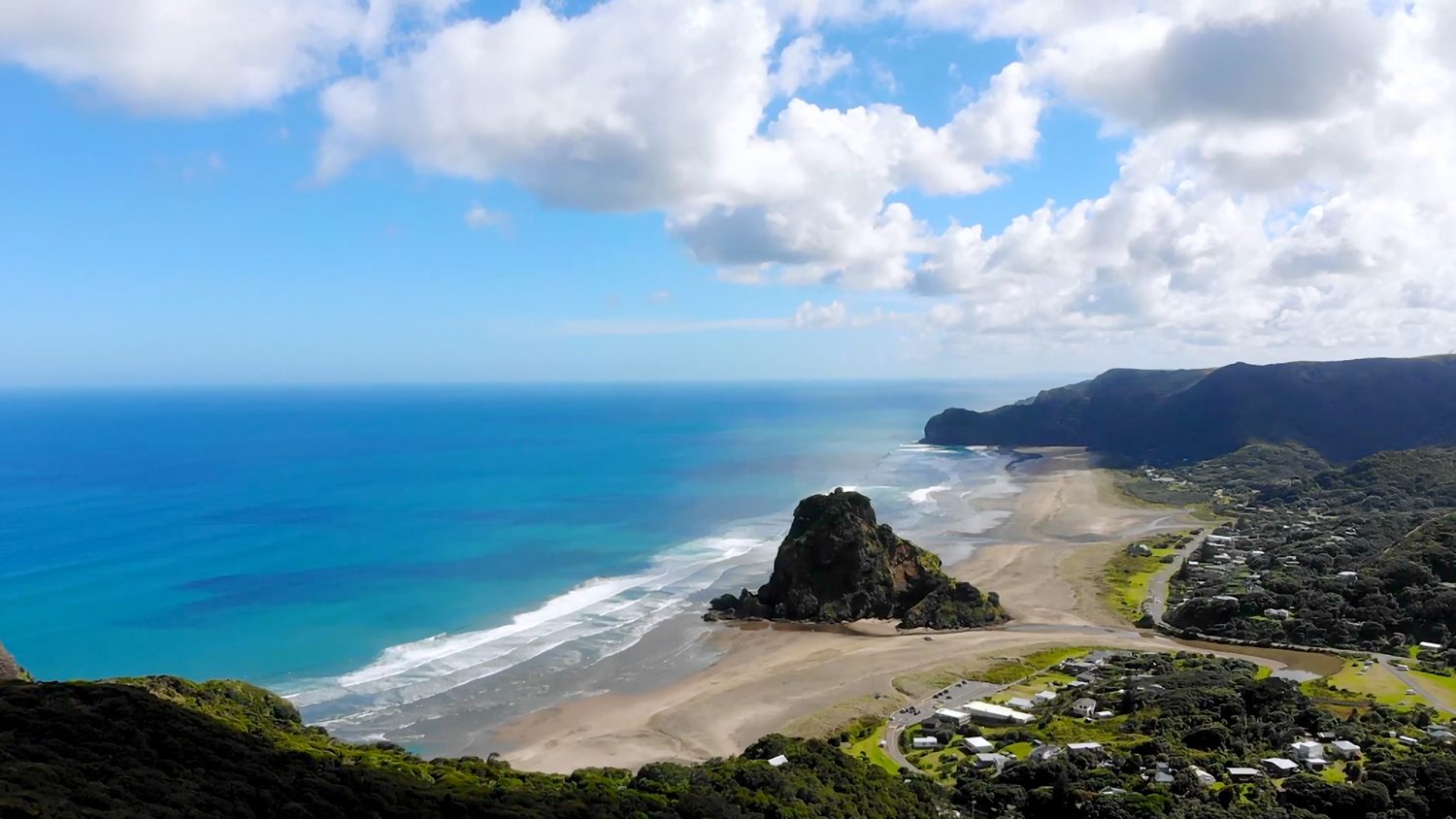
Piha Beach is split into three zones by Lion Rock:
- South Piha — the southern stretch, calmer waters, family-friendly area, surf lifeguards in summer
- Lion Rock — the rock that divides the beach. Its track is closed, so this is one to admire from the sand
- North Piha — the northern stretch, slightly wilder, popular with experienced surfers
It is a long beach of black volcanic ironsand, and the dark sand gets very hot in summer, so wear shoes or sandals. Behind the beach lies Piha Village (small population, several cafés, the Piha Surf Life Saving Club, a small store).
The black sand deserves a moment. It is ironsand — titanomagnetite eroded out of old volcanic rock, much of it originally from the Taranaki volcanoes far to the south. It is why a magnet dragged through Piha sand comes up furry, and why it gets hot enough on a sunny summer day to hurt bare feet.
The village behind is smaller than first-timers expect: a store, a couple of cafes, two surf clubs, a campground and a lot of baches on stilts up the hillside. The lagoon at the southern end, where the Piha Stream reaches the sea, is where families with small children gather because it is sheltered — though water quality there often drops after rain. A kilometre further south is The Gap, a blowhole that is spectacular at low tide and dangerous close up; the Tasman Lookout Track that leads to it has been closed since the 2023 storms.
Piha Swim Safety
Piha Beach has dangerous Tasman Sea rip currents. Read these rules before swimming:
- Only swim between the red and yellow flags. Not near them. Between them
- Two clubs patrol Piha — Piha Surf Life Saving Club south of Lion Rock and United North Piha Lifeguard Service to the north, so flags may sit in different places on each half of the beach
- The patrol season runs from late October to April, and outside it there are no lifeguards on the beach
- Outside patrol times, stay out of the water. Once the flags come down, nobody is on watch
- If you are caught in a rip: do not fight it. Float, raise one arm and shout, and let it carry you out, because rips lose power beyond the breakers. If you can swim, go parallel to the beach towards the breaking waves
- Check Safeswim before you drive out for water quality and patrol status
It is worth being blunt about why Piha differs from a sheltered harbour beach. This is open Tasman coast with no reef and no headland shelter, and a big consistent swell running straight in. The rips shift, sometimes within an hour, and they are often invisible to an untrained eye — a flat, calm-looking patch between two lines of breaking waves can be a rip rather than the safe bit. That deceptive calm is why strong swimmers get into trouble here as readily as weak ones. Spend two minutes looking down at the water from the access road first, and if the flags are not up, the answer is no.
Surfing Piha

Piha is Auckland’s premier surfing beach with consistent year-round waves. The Tasman Sea swell often delivers surf, but conditions change from day to day, from small beginner waves to serious breaks for experienced surfers, so check Safeswim before you paddle out.
Surf lessons
- Piha Surf School — the long-running local operator. Group lessons cost NZ$80 per adult and NZ$70 for under-16s, and private lessons NZ$150 per person
- Lessons run through the day in summer and typically weekends only in winter, scheduled around tide and swell
- Board, wetsuit and instruction included — you need swimwear and a towel
- Kids are welcome: lessons run inside the patrolled area during the season, and outside a lesson children should stay between the red and yellow flags with an adult
- Book ahead in summer. A lesson is by far the safest way for a beginner to get in the water at Piha
Surf hire
- Boards from around NZ$40 for a half day at the time of writing
- Wetsuits from around NZ$25, and you will want one year-round — the Tasman here runs from about 20°C in late summer down to roughly 14°C in winter
- Available at the surf school and the Piha Store, but stock is finite on a hot weekend and hire shuts early out of season
Lion Rock
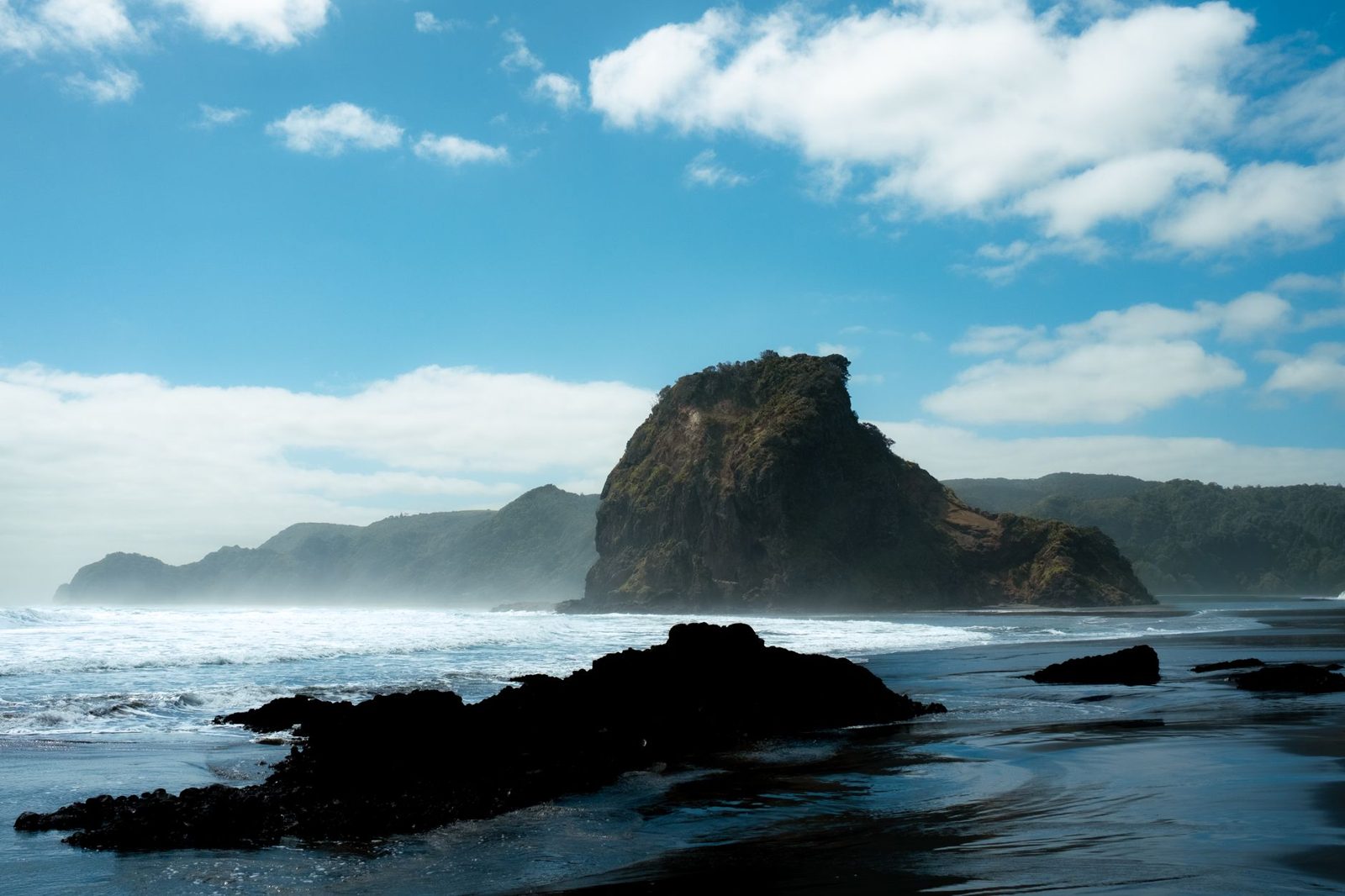
The track up Lion Rock is closed after storm damage and is unsafe, so there is no way up the rock for now; check Auckland Council’s current track status before you visit. It still dominates the beach, and the best views of it are from the sand and from the lookout on Piha Road as you drive in.
Its Māori name is Te Piha, describing the pattern the waves make breaking against it, and the settlement took its name from the rock. The summit was the site of Whakaari pā — surveys have found terraces, middens and fragments of pre-European woven cloak up there.
Kitekite Falls Walk: Piha’s Signature Waterfall

Kitekite Falls is Piha’s signature 40-metre waterfall, accessible via an easy 1-hour return walk through native rainforest. The track follows the Glen Esk Stream, crosses several boardwalks, and rewards with a stunning multi-tiered waterfall and swimming hole at the base.
- Time: 1 hour return
- Difficulty: Easy, well-formed gravel track
- Highlights: Native bush, multi-tiered waterfall, swimming hole
- Start: Glen Esk Road carpark (signposted from Piha Village)
The pool at the base is tea-coloured rather than dirty — that is tannin leached out of the native bush, and it is normal. It is also cold, all year. Two cautions: water quality drops sharply after heavy rain, and people have been badly hurt jumping from the rocks, where depth is impossible to judge from above. Wade in rather than leap in. A second pool between the tiers is closed off for kauri protection, so stick to the marked area at the bottom.
The falls are a three-tiered drop of roughly 40 metres on the Glen Esk Stream, loud and full after a wet week and a thin ribbon after a dry February. Parking at the Glen Esk Road trailhead is limited, and on a busy day walking up from the village can beat circling for a space. For more in the same forest, see our guide to Waitākere Ranges hikes.
Other Waitākere Ranges Walks Near Piha

- Comans Track — descends from Log Race Road towards Karekare, with Tasman Sea views
- Mercer Bay Loop — 1 hour return, dramatic clifftop walk
- The Pohutukawa Glade Walk — 15 mins, great for families
- Ahu Ahu Track — open again, listed on Auckland Council’s track status table
- Tasman Lookout Track — closed since the 2023 storms, so the viewpoint above The Gap is off the list for now
- Karekare Falls walk (at neighbouring Karekare Beach) — the falls lookout is about 5 minutes on foot from the trailhead
Note: many Waitākere Ranges walking tracks have been closed in recent years to prevent the spread of kauri dieback disease. Check Auckland Council’s Tracks & Walks page before your visit and follow all kauri hygiene stations (boot scrub stations) at track entrances.
Kauri Dieback: Why So Many Tracks Are Shut
This is the thing out-of-date Piha guides get wrong most often. Kauri dieback is caused by a soil-borne pathogen, Phytophthora agathidicida, which attacks the roots of kauri and kills the tree. There is no cure, and it travels in soil — on boots, tyres, dogs and bikes.
In December 2017 Te Kawerau ā Maki, the iwi whose rohe this is, placed a rāhui over the forested parts of the Waitākere Ranges. Auckland Council followed with widespread track closures from May 2018. Many tracks have since reopened after upgrades with boardwalks and gravel, while others remain closed, so check Auckland Council’s current track information before you go.
- Check before you drive out. Auckland Council publishes current track status and it changes
- Use every cleaning station. Scrub the soil off, then spray, going in and coming out
- Stay on the formed track and off the roots. Kauri roots spread far wider than the canopy and sit shallow, so stepping around a muddy patch is exactly the wrong instinct
- Do not enter a closed track, and leave the dog at home — there are fines, and dogs are an ideal soil vector
None of this makes Piha a bad day out. The beach and the Kitekite Falls walk have generally stayed available, though storm damage has closed the Lion Rock and Tasman Lookout tracks. It does mean building the day around one confirmed-open walk.
Eating at Piha
- Piha Store — burgers, fish & chips, ice cream, takeaway
- Piha RSA — community-owned, casual pub fare on weekends
Allow NZ$20–30 per person for a Piha lunch. Bring snacks if you’re walking the falls — there are no facilities on the trail.
Be realistic about opening hours. Piha runs on a summer economy: in January everything is open and there is a queue, and in midwinter several places shut midweek or close mid-afternoon. Nothing is open late, so if the plan is dinner then sunset, check first or bring a picnic.
Piha Beach Day Trip: Sample Itinerary
- 9am — Leave Auckland CBD via SH16 west
- 9:45am — Coffee stop in Titirangi Village
- 10:30am — Arrive Piha, walk on the beach
- 11am — Photos of Lion Rock from the sand
- 12pm — Lunch in the village or a picnic (check cafe opening days before you go)
- 1:30pm — Drive 5 mins to Kitekite Falls trailhead
- 1:45pm — Walk to Kitekite Falls
- 3pm — Swim at the falls or back at the beach
- 4:30pm — Sunset on Piha Beach (winter — later in summer)
- 5:30pm — Drive back to Auckland
- 6:30pm — Arrive Auckland CBD
That is the summer version. In winter, flip it: do the falls first while light is still coming through the canopy, then take the beach in the afternoon and be on the road home by about 5:30pm.
With only half a day, drive straight to Glen Esk Road, walk to Kitekite Falls and back, then go down to the beach for a look at Lion Rock — about three hours on the ground and five door to door. If you want a bigger loop, Piha pairs with a second west coast beach: Karekare lies to the south and Bethells to the north, so check the driving route before you commit. Two beaches in a day is comfortable; three is a driving day with beaches attached.
Best Time to Visit Piha

- Summer (Dec–Feb) — best weather, surf lifeguards, hottest beach. Weekends get busy, so arrive early.
- Autumn (Mar–May) — perfect — fewer crowds, settled weather, sea still warm
- Winter (Jun–Aug) — dramatic surf, often empty beaches, excellent for photographers
- Spring (Sep–Nov) — variable but improving
Sunset is the magic hour at Piha. The west-facing beach catches the sun setting over the Tasman Sea, with Lion Rock silhouetted dramatically. Plan to arrive at the beach by 5pm in winter or 8pm in summer for sunset.
What to Bring
- Plenty of water
- Snacks or picnic lunch
- Sunscreen — west coast UV is intense
- Hat and sunglasses
- Closed walking shoes for the falls track
- Sandals for the beach (sand gets very hot)
- Towel and swimwear (only between flags)
- Camera
- Light jacket — west coast can be windy
Two additions. Bring cash, because coverage here is patchy and eftpos goes down with it. And take walking shoes for the falls track plus jandals for the sand — the ironsand burns bare feet in midsummer, while the tracks are muddy enough that beach shoes will let you down. More kit advice is in our Auckland packing list.
Piha vs Karekare vs Bethells
- Piha — most popular, has cafés, surf lessons, Lion Rock
- Karekare — wildest, most isolated, The Piano filming location
- Bethells — most varied (beach + dunes + Lake Wainamu)
The ideal day trip combines two: Piha morning + Karekare afternoon, or Bethells morning + Piha sunset, or Piha plus the gannet colony at Muriwai half an hour up the coast.
Piha Photography
- Lion Rock at sunset — silhouette against the Tasman Sea
- Kitekite Falls long exposure — soft cascading water in native bush
- South Piha foreshore — black sand patterns at low tide
- The drive in — winding through native bush
Drone restrictions apply in the Waitākere Ranges Regional Park — check Auckland Council’s drone rules.
Piha With Kids
Piha is family-friendly, and one of the easiest family day trips from Auckland, with these specific attractions:
- Surf lifesaving flags (only swim within them)
- The lagoon area near the river mouth (calmer for kids)
- Kitekite Falls walk — easy track, lots of nature interest
- Piha Store — kids’ menu options
- Piha Domain campground for a sleepover — open again for the 2026/27 summer, around NZ$30-40 per adult per night
The honest version for families: Piha is a brilliant day out with children and a demanding one with toddlers, because there is no shallow sheltered swimming here the way there is at Mission Bay. Set the flag rule before you get out of the car, and do Kitekite Falls first while legs are fresh. For gentler options, see our roundup of family day trips from Auckland.
Staying Overnight at Piha
- Piha Domain Campground — basic camping, open month to month through the 2026/27 summer season, NZ$30–50/night
- Piha holiday cottages (Bookabach) — bach-style holiday rentals, NZ$220–450/night
- Piha Beach House — boutique B&B, NZ$280/night
- Multiple Airbnbs — bushside and beachside properties
Piha History & Culture

Piha sits in the rohe of Te Kawerau ā Maki, and the area carried a number of pā and kāinga — Whakaari pā on Lion Rock, and a headland site at Te Waha Point, where the karaka trees planted around the old settlement still grow, one thread in the wider story of Auckland’s Māori history and heritage. European activity began in earnest in the late nineteenth century with kauri milling and gum digging. By 1900, holidaymakers were coming out by coach from Glen Eden to stay in guest houses.
Piha Surf Life Saving Club was founded in 1934 and is one of the country’s best known, largely thanks to the long-running television series filmed here. Piha is also credited as the birthplace of New Zealand board riding, in 1958. Today the settlement has just over a thousand permanent residents — a little over 1,040 at the last census — and many times that on a hot Sunday.
Frequently Asked Questions
How far is Piha Beach from Auckland?
About 39km west of Auckland’s city centre, or around an hour by car.
Can you swim at Piha Beach?
Yes, but only between red and yellow flags during summer lifeguard patrols. Outside patrol hours, do not swim — strong rip currents.
Is there public transport to Piha?
No. You need a car or organised tour. Auckland tour companies offer Piha day trips for NZ$130–180 per person.
Can you climb Lion Rock?
No. The Lion Rock track is closed, so there is no way up the rock for now. Admire it from the sand or from the lookout on Piha Road, and check Auckland Council’s track status before you visit.
How long is the Kitekite Falls walk?
1 hour return on an easy gravel track. Family-friendly.
Is Piha worth a day trip from Auckland?
Absolutely yes. Piha is Auckland’s most iconic day trip, combining wild beach, hiking, surfing and the spectacular Lion Rock, with only a day on Waiheke Island rivalling it for first-timers.
Are dogs allowed at Piha?
Yes, on leash on most of the beach. Off-leash zones during certain hours. Check Auckland Council’s beach dog rules for current details.
Is the Kitekite Falls track open?
It has generally been one of the tracks kept open through the Waitākere Ranges kauri dieback closures, but status changes and closures follow storms. Check Auckland Council’s track page the day before you go rather than relying on any guide, including this one.
Can you see the sunset at Piha in winter?
Yes, and winter is arguably the better season for it: the sun sets around 5pm in June, the beach is quieter and the storm light over the Tasman is spectacular. The catch is driving Piha Road back in the dark and often in rain.
Final Take: Auckland’s Best Day Trip
A Piha Beach day trip combines wild Tasman Sea coastline, native bush rainforest, the iconic Lion Rock, and the Kitekite Falls walk — all about an hour’s drive from the city centre. For first-time Auckland visitors, this is the day trip to prioritise.
Bring everything you need (water, food, sunscreen, sturdy shoes), aim for the Kitekite Falls walk in the morning, lunch in the village, beach time in the afternoon, sunset over the Tasman — and you’ll have one of Auckland’s best memories.